
Introduction
Most businesses that say they’re “using AI” are using a chatbot. That’s not a criticism it’s just worth being honest about. A chatbot is a useful tool. But calling it AI strategy is a bit like saying you’ve digitized your business because you switched from a paper calendar to Google Calendar.
The distinction matters now because the business stakes are rising. A 2024 Salesforce survey found that 84% of IT leaders believe AI agents will fundamentally change how organizations operate within the next three years. Meanwhile, McKinsey’s latest AI adoption data shows that companies deploying AI beyond simple chat interfaces are seeing 3–4x more measurable impact on revenue and cost efficiency than those who aren’t.
Something is happening at the frontier of AI that most business coverage is not explaining clearly and it’s creating a gap between companies that think they’re using AI and companies that actually are.
This article is about that gap.
What Is a Chatbot, Really?
Let’s start with the simple version, because the simple version is actually accurate.
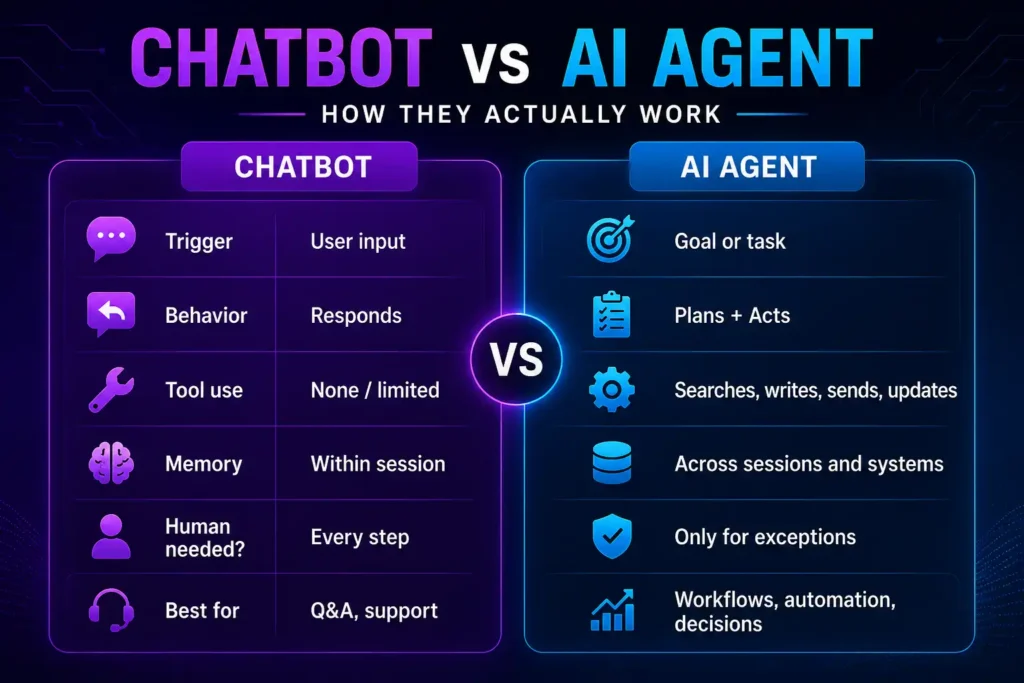
A chatbot is a system that responds to inputs. You type something, it generates a reply. The more sophisticated ones powered by large language models can handle nuanced language, remember context within a conversation, and sound remarkably human. But at its core, a chatbot is reactive. It waits. It responds. It stops there.
Think of a chatbot like a very well-read customer service rep who only picks up the phone when you call, answers your question, and then hangs up. They don’t follow up. They don’t check your account before you call. They don’t flag that your subscription is about to expire or that your last three support tickets were about the same issue.
They answer. That’s it.
For a lot of use cases FAQ handling, basic lead qualification, simple customer queries that’s genuinely useful. But it has a ceiling.
Read Also : How AI Reasoning Models Work: O3, Gemini Thinking, and the Future of Deep Thinking AI
What Is an AI Agent?
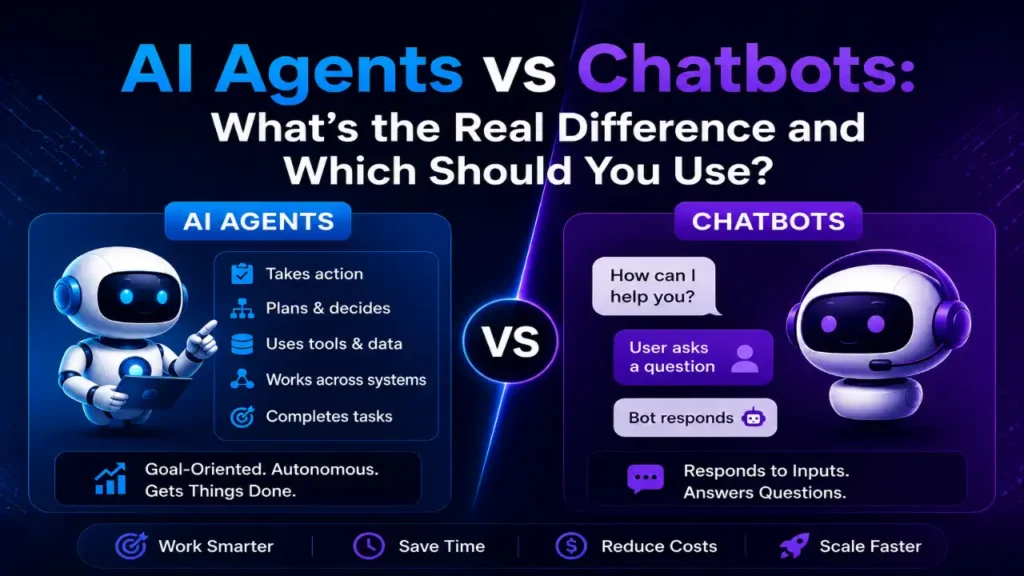
An AI agent is a system that doesn’t just respond it acts.
Give an agent a goal, and it figures out the steps required to reach that goal. It can use tools (search the web, query a database, send an email, update a CRM record), make decisions along the way, course-correct when something doesn’t work, and loop back to check whether it’s actually done what it set out to do.
The mental model that helps most people: a chatbot is like an employee who only responds to direct questions. An AI agent is like an employee you can hand a project to and trust them to figure out the steps checking in when they hit something genuinely ambiguous, but otherwise just getting it done.
A few practical examples:
- A chatbot answers “what’s the status of my order?” An agent notices your order has been delayed, proactively emails you with an updated timeline, offers a discount code, and logs the interaction in your CRM without anyone asking.
- A chatbot qualifies a lead through a scripted form. An agent researches the company, scores the lead based on fit, drafts a personalized outreach message, adds the contact to the right CRM pipeline, and schedules a follow-up reminder in minutes.
- A chatbot answers HR policy questions. An agent processes a leave request, checks availability against team schedules, routes it for approval, sends confirmations, and updates the relevant calendar entries.
The difference isn’t cosmetic. It’s architectural.
Why Businesses Are Still Confused About This
Part of the confusion is the marketing. Every software vendor selling a chatbot calls it an “AI agent” now. The terms get used interchangeably in press releases, demo videos, and sales decks which makes it genuinely hard for business buyers to know what they’re actually purchasing.
Here’s a practical test: Does it take actions, or does it take turns?
If your AI tool takes a turn waits for your input, generates a response, waits for your next input it’s a chatbot, however sophisticated the underlying model is.
If your AI tool can be handed a goal and autonomously execute a sequence of steps across multiple systems without prompting at each stage that’s an agent.
Most of what businesses are currently running is the first thing. The second is rarer, harder to set up, and significantly more powerful.
The Real-World Business Cases Broken Down by Function
Customer Support
Chatbot: Handles tier-1 queries. Deflects simple questions from human agents. Useful, measurable ROI, easy to implement.
AI Agent: Handles tier-1 AND tier-2 queries, identifies patterns across multiple customer complaints, triggers proactive outreach when problems are detected, escalates to humans only when genuinely necessary with full context already summarized.
The agent doesn’t just save time on individual conversations. It changes the economics of your entire support function.
Sales and Lead Management
Chatbot: Qualifies inbound leads through a scripted flow. Captures name, email, company size, budget. Useful for high-volume top-of-funnel.
AI Agent: Researches each inbound lead, scores them against your ICP, personalizes the first outreach, books the call, updates the CRM, and follows up if there’s no response all without a sales rep touching it until the call actually happens.
For lean sales teams, this is significant. One agent can run the early-stage pipeline that would otherwise require a full-time SDR.
Internal Operations
Chatbot: Answers employee questions about policy, process, or company information. Reduces load on HR and ops teams.
AI Agent: Processes requests. Routes approvals. Coordinates across departments. Flags exceptions. Generates reports. An agent embedded in your operations isn’t answering questions about the process it’s running part of the process.
Which One Should You Actually Use?
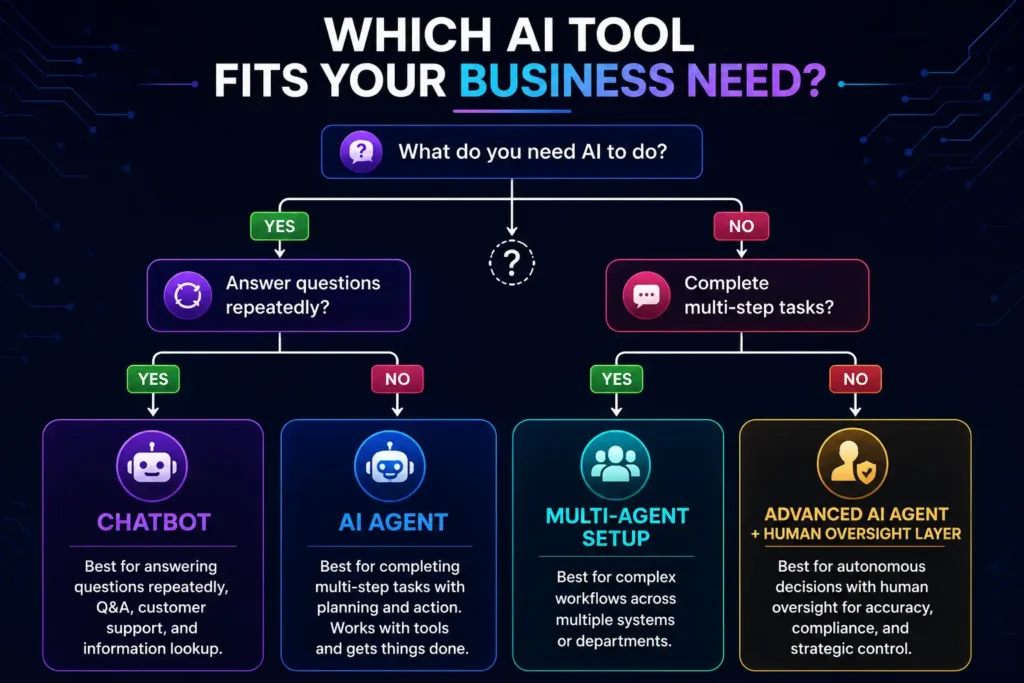
The honest answer: probably both, for different things. But the decision framework is simpler than most vendors make it seem.
Start with a chatbot if:
- You’re handling high-volume, repetitive questions with relatively consistent answers
- Your main goal is deflection reducing the number of queries that reach a human
- You’re new to AI tooling and need a low-risk, fast-to-deploy starting point
- Your use case has a clear, bounded scope (e.g., product FAQ, booking confirmation queries)
Move to an agent if:
- Your workflow involves multiple steps that currently require human coordination
- You need the AI to interact with other systems (CRM, calendar, email, databases)
- The value is in completing tasks, not just answering questions
- You’re trying to reduce headcount on repetitive knowledge work, not just call volume
The practical reality: most businesses should deploy chatbots now to solve immediate, high-volume problems and spend the next six to twelve months identifying the workflows that would benefit from agent-level automation.
The Practical Challenges Nobody Talks About
Agents are more powerful but they’re also more complex to deploy responsibly.
Integration overhead is real. A chatbot sits on top of your website or Slack. An agent needs to connect to your CRM, your email, your calendar, your support system. That integration work takes time and technical judgment to get right.
Error propagation is a different kind of risk. When a chatbot gives a wrong answer, a human reads it and pushes back. When an agent takes a wrong action sends the wrong email, updates the wrong record, schedules the wrong meeting the error is already in the world before anyone notices. Human checkpoints matter more with agents, not less.
Trust and oversight isn’t just a philosophical concern. It’s operationally important. The businesses seeing the best results from AI agents are the ones that built in review layers for consequential actions not because the AI can’t be trusted, but because the cost of a mistake is higher than the cost of a quick human check.
Cost structure is also different. Chatbots are cheap. Agents particularly ones running on powerful reasoning models, making dozens of decisions per task can be significantly more expensive per interaction. The ROI is usually still strong, but it needs to be calculated honestly, not assumed.
What the Next Two Years Actually Look Like
The gap between chatbot-level and agent-level AI is closing fast but not evenly.
The businesses that figure out agent deployment in 2025 and 2026 will have a structural advantage heading into 2028 and beyond. Not because they’ll have better technology, but because they’ll have already solved the hard problems: integration, workflow design, human oversight, and trust calibration. Those aren’t technical problems they’re operational ones. And operational experience doesn’t transfer to competitors easily.
Chatbots will remain useful. They solve real problems at low cost and low complexity. But as AI agents become more accessible and they will businesses that never moved beyond the chatbot layer will find themselves doing manually what their competitors automated two years earlier.
Conclusion
The chatbot versus agent distinction isn’t academic. It maps directly onto what kind of work you’re asking AI to do and what kind of results you can realistically expect.
Chatbots are tools. Good ones, but tools. You use them; they don’t run anything without you. Agents are closer to systems capable of handling workflows end-to-end, across multiple platforms, with a level of autonomy that changes how teams are structured and how work gets done.
The right question for your business isn’t “should we use AI?” Most organizations past a certain size already are. The right question is: “Are we using AI at the task level or the workflow level?” Because the difference in business impact between those two answers is not marginal.
If you’re still at the chatbot stage, that’s a fine place to start but it shouldn’t be where you finish. The businesses that are building real competitive advantage with AI right now are the ones that moved from answering questions to completing work.
That shift is available to most organizations. It just requires being honest about where you currently are.

- Difference Between Image Resolution and Image Size: Complete Guide (2026) - July 13, 2026
- How Much Does AI Software Cost for Startups in 2026? - July 7, 2026
- How to Use AI to Write Blog Posts Faster Without Losing Your Voice - June 28, 2026