
Introduction
Something shifted quietly over the last eighteen months. Businesses that had written off AI as a productivity novelty a glorified autocomplete started noticing something different. The models weren’t just answering questions faster. They were actually reasoning through problems.
A McKinsey report from early 2025 found that AI adoption among enterprises had crossed 70%, up from under 50% just two years earlier. More telling was where that adoption was happening: not in simple content generation, but in decision-support, financial modeling, and complex research tasks. That’s not a coincidence. It tracks directly with a new class of AI what researchers and builders now call reasoning models.
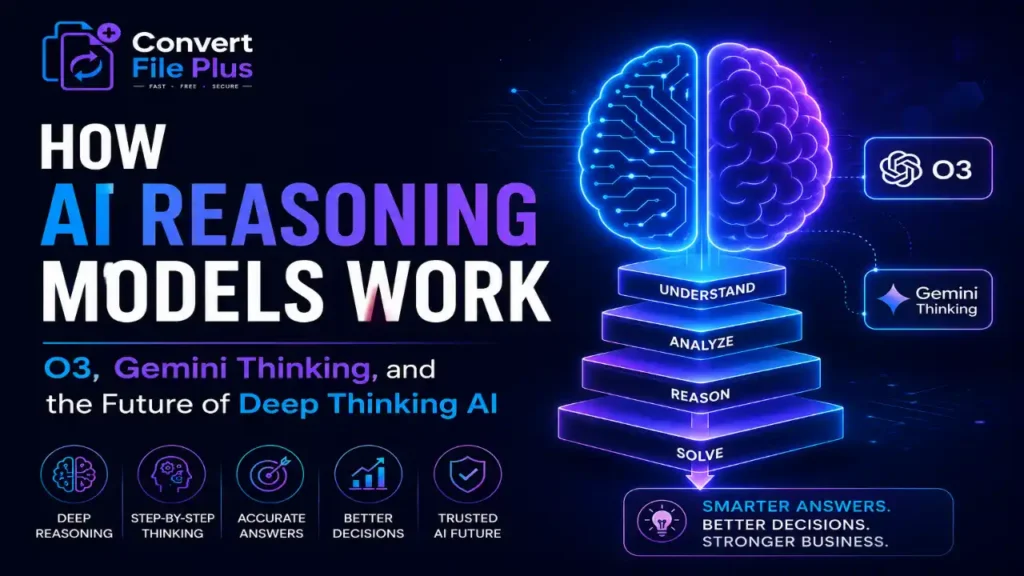
Most people have heard of ChatGPT or Gemini in passing. Far fewer understand that underneath the surface, a new architecture has quietly replaced the old one for high-stakes thinking tasks. Models like OpenAI’s O3 and Google’s Gemini Thinking don’t just predict the next word. They pause, plan, and work through problems the way a methodical analyst would.
If you’re running a business or responsible for one this distinction matters more than the AI hype cycle suggests. And the window to understand it, before it reshapes workflows and competitive dynamics, is narrowing faster than most people realize.
Read Also : How Google AI Overview Is Transforming SEO and Search Results
What Exactly Is an AI Reasoning Model?
Most AI systems work on a simple principle: given input, produce output. Fast. The model sees a question and generates an answer, token by token, without stopping to reconsider.
Reasoning models work differently. They’re trained to think through problems in steps sometimes hundreds of steps before committing to a final answer. It’s the difference between a junior employee who blurts out the first answer that comes to mind and a senior consultant who maps the problem before speaking.
O3, released by OpenAI in late 2024, was the first model to demonstrate this capability at scale. It could solve graduate-level math problems, pass rigorous coding benchmarks, and work through multi-step logic that earlier models simply couldn’t handle. Google followed with Gemini Thinking, applying similar principles across scientific reasoning and long-document analysis.
The practical implication: these models are finally good enough for tasks that actually matter in business not just drafting emails, but analyzing complex contracts, auditing financial logic, or reasoning through regulatory compliance questions.
Why Businesses Are Moving Beyond Chatbots
There’s an important distinction that often gets lost in vendor marketing.
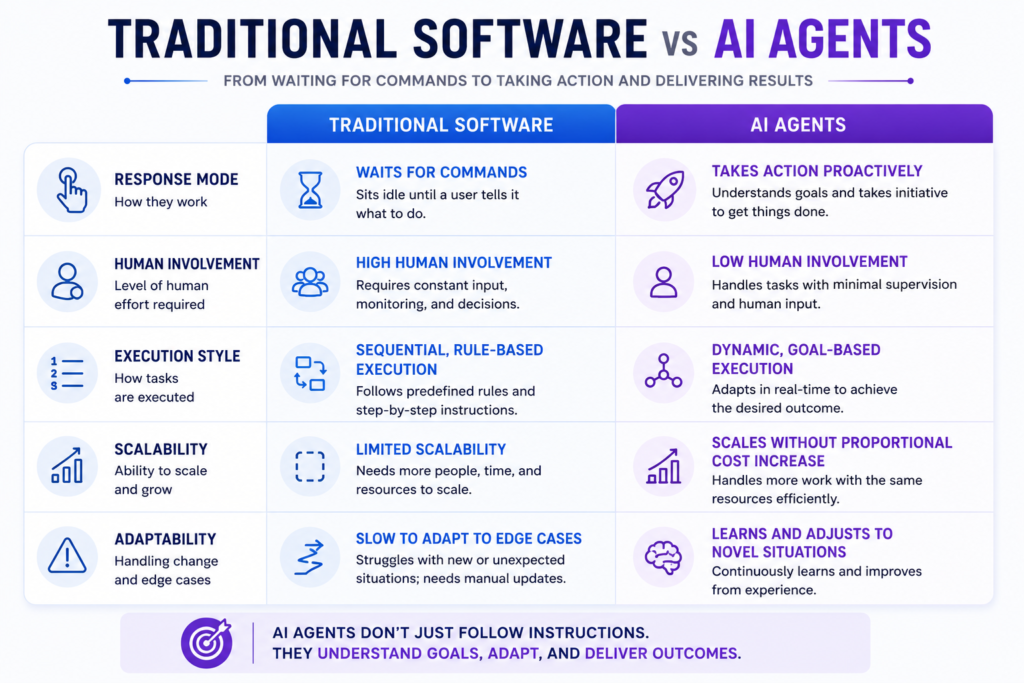
A chatbot retrieves or generates information. It’s reactive. You ask, it answers. An AI reasoning model doesn’t just retrieve it works. It can be given a goal, a set of constraints, and context, and then figure out the path to get there.
The difference shows up clearly in practice:
- Customer support: A chatbot answers FAQs. A reasoning model can review a customer’s full account history, identify what went wrong, determine the correct resolution policy, and draft a tailored response without human escalation.
- Operations: Traditional automation follows rules. Reasoning models can evaluate trade-offs, handle edge cases, and flag situations where the rules don’t apply cleanly.
- Sales: A chatbot qualifies leads with scripted questions. A reasoning model can analyze a prospect’s business context, cross-reference it with past deal patterns, and suggest a specific pitch angle personalized, not templated.
The gap between “answers questions” and “solves problems” is where most of the real business value lives.
Designer Note: Create a side-by-side comparison table or split visual showing:
The Real Business Problems AI Reasoning Models Can Solve
Let’s be specific, because this is where the conversation usually gets too abstract.
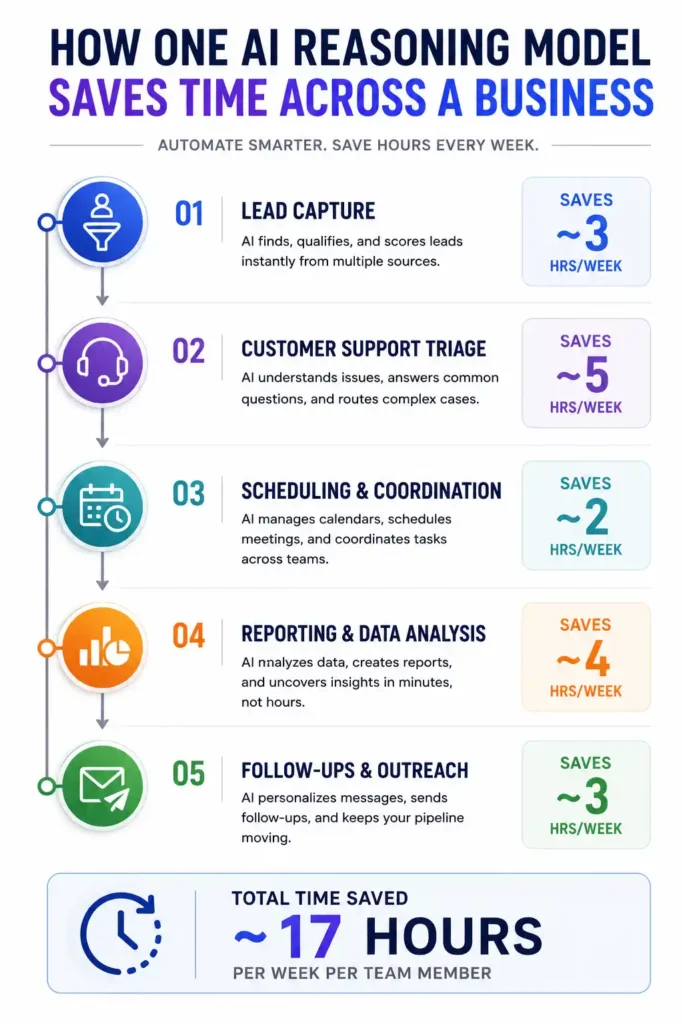
Customer service is the most obvious starting point. Reasoning models can handle nuanced complaints, interpret ambiguous requests, and de-escalate emotionally charged interactions because they can hold context and weigh multiple factors at once, not just pattern-match to a scripted response.
Internal operations is where the efficiency gains get interesting. Think of all the decisions your team makes that follow a general logic but require judgment: approving vendor invoices that don’t match exactly, routing support tickets that fall between categories, flagging financial anomalies that aren’t technically wrong but look unusual. Reasoning models handle these well.
Lead generation and qualification is another area. A well-configured reasoning model can research a prospect, score them based on fit, and draft an outreach message in minutes, not days.
Data analysis is perhaps the most underrated application. Most business data is messy, inconsistent, and stored across multiple systems. Reasoning models are unusually good at working through ambiguous data sets, surfacing what matters, and explaining their logic which makes them genuinely useful rather than just fast.
Scheduling and coordination might sound simple, but for teams managing complex calendars, multi-party dependencies, or resource constraints, the combinatorial problem is hard. Reasoning models handle it without complaint.
Why Smaller Businesses May Benefit More Than Enterprises
Enterprise organizations have entire IT departments, vendor contracts, and months-long procurement cycles. A 10-person team doesn’t.
That’s actually an advantage right now.
Small businesses can move fast. There’s no bureaucracy deciding which AI tool gets approved. No six-month implementation project. A founder or operations manager can identify a painful, repetitive workflow this week and have an AI reasoning system handling part of it next week.
The economics are also compelling. Hiring a skilled analyst, customer support lead, or operations coordinator costs real money and takes time. A reasoning model doesn’t replace that person entirely, but it can handle 60–70% of the workload that was consuming their hours. For a lean team, that’s the difference between keeping up and falling behind.
Larger companies will get there too. They just move slower.
The Economics Behind AI Reasoning Models
The numbers are starting to look serious.
A Stanford HAI report from 2025 noted that businesses deploying advanced AI models were reporting productivity gains in the range of 20–40% for knowledge-work tasks. That’s not a marginal improvement it changes how you staff projects and what timelines you can credibly commit to.
The cost picture is also shifting. Early AI APIs were expensive and slow. O3 and its counterparts are dramatically faster and cheaper than they were eighteen months ago, with pricing models that make per-task economics viable even for small-scale operations.
Competitive advantage is probably the most important economic variable, and the hardest to quantify. When one company in your space is running reasoning models to accelerate research, analysis, and decision-making and you’re not the gap compounds quietly. It doesn’t show up in one quarter. It shows up over two years.
Challenges Businesses Need to Consider
None of this is without friction, and it’s worth being clear-eyed about that.
Data privacy is the most immediate concern. Reasoning models often require substantial context to work well which means feeding them business data, customer information, or internal documents. Understanding where that data goes, how it’s stored, and what the vendor’s policies are isn’t optional. It’s basic due diligence.
Reliability is a real limitation. These models are significantly better than they were, but they still make mistakes sometimes confidently. Deploying them in high-stakes decisions without human review is a risk most businesses shouldn’t take yet.
Human oversight isn’t just a safety recommendation it’s operationally important. The businesses seeing the best results from AI reasoning tools are the ones where humans stay in the loop on consequential outputs, using AI to accelerate their work rather than replace their judgment entirely.
Security deserves attention, especially for businesses in regulated industries. An AI model that can reason through complex workflows is also a system that has access to complex data. That access needs to be carefully scoped and audited.
Regulatory risk is emerging slowly but steadily. The EU AI Act and various sector-specific regulations are creating new obligations around AI use in certain contexts. Businesses should track this not to avoid AI, but to deploy it thoughtfully.
What Businesses Should Do Today to Prepare for 2030
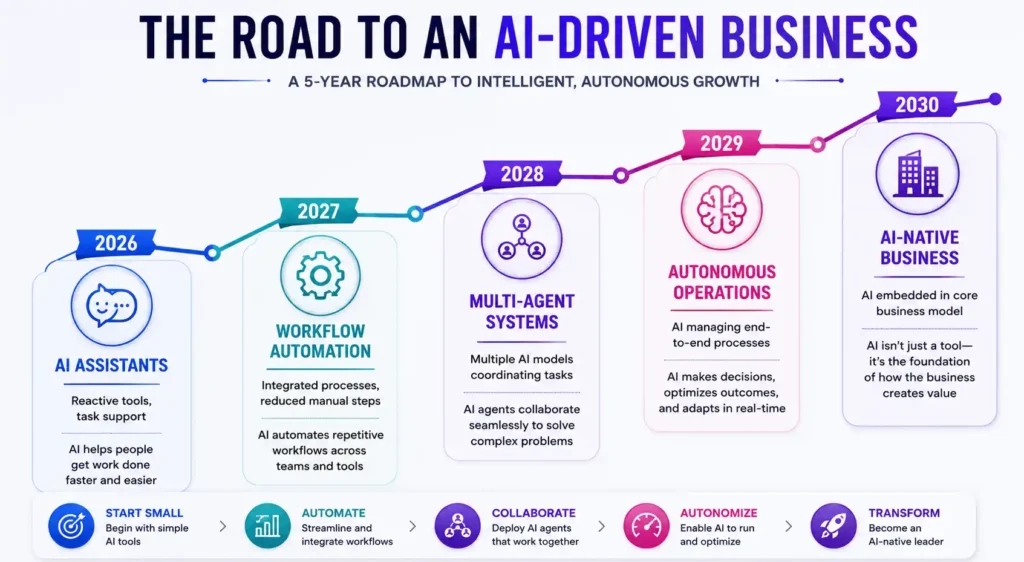
The year 2030 sounds far away. It’s not. Four years, in business time, is two strategic planning cycles.
Here’s what actually matters right now:
- Start with one use case. Not five. Pick the most painful, repetitive, time-consuming task your team handles and build one experiment around it. Learn from that before scaling.
- Build AI literacy across your team. Not everyone needs to become a prompt engineer, but everyone should understand what these tools can and can’t do. Uninformed skepticism and uncritical enthusiasm are equally expensive mistakes.
- Map your repetitive workflows. The highest-value AI applications are almost always in tasks that happen dozens of times a week not once a month. Find those and prioritize them.
- Experiment with automation frameworks. Tools like n8n, Make, and purpose-built AI agent platforms are lowering the barrier significantly. You don’t need an engineering team to start.
- Keep humans in the loop. At least for now. The goal is augmentation, not abdication.
Conclusion
What O3 and Gemini Thinking represent isn’t just a technical upgrade. They represent a shift in what AI is actually useful for. The move from “answer a question” to “reason through a problem” is the kind of change that takes a few years to show up in business outcomes and then shows up everywhere at once.
The businesses that will handle this transition best aren’t necessarily the ones that adopt AI fastest. They’re the ones that adopt it most deliberately identifying where reasoning tools genuinely help, being honest about where they fall short, and keeping skilled people in the decision-making chain where it matters.
AI reasoning models won’t replace your team’s judgment. But they will change the rate at which your team can apply that judgment to more problems, with better information, in less time. That’s a meaningful shift in what a lean, well-run business can accomplish.
The professionals who figure this out early not by chasing every new model release, but by building real understanding of what these tools can do will have a significant edge. Not because they have access to better technology. Because they’ll know how to use it.
If this gave you something to think about, I’d be curious what use cases you’re exploring in your own business. The most interesting applications I’ve come across haven’t been from the largest companies they’ve been from small teams moving quickly with clear-eyed thinking.

- Difference Between Image Resolution and Image Size: Complete Guide (2026) - July 13, 2026
- How Much Does AI Software Cost for Startups in 2026? - July 7, 2026
- How to Use AI to Write Blog Posts Faster Without Losing Your Voice - June 28, 2026