Convertfile

Digital Marketing & Social Media

Digital Marketing & Social Media

Content Marketing Strategy for 2026: How to Create Content That AI Search Will Love

Introduction Something fundamental changed in how people search for information  and most businesses haven’t caught up yet. A year ago, ranking on Google’s first page was the goal. Today, buyers are getting answers directly from AI tools like ChatGPT, Perplexity, Google’s AI Overviews, and Gemini  without clicking a single link. If your content isn’t showing up inside those AI-generated answers, you’re invisible to a growing segment of your market. According to a 2025 Gartner report, traditional search engine volume is expected to drop by 25% by 2026 as AI-powered assistants handle more queries directly. Separately, BrightEdge research found that AI Overviews now appear in over 84% of search queries across key categories. This isn’t a future trend. It’s already happening. The businesses paying attention right now are asking a different question. Not “how do we rank on Google?” but “how do we become the source that AI systems trust and cite?” That shift in thinking is what separates content strategies that will work in 2026 from the ones that are quietly becoming obsolete. Before 2030, AI-mediated search will be the default for most professional and consumer research. The brands that build for that reality now will have compounding authority advantages that latecomers simply won’t be able to close. What Exactly Is AI Search  And Why Does It Work Differently? AI search doesn’t rank pages. It synthesizes answers. When someone asks Perplexity or ChatGPT a question, the system pulls from multiple sources, evaluates credibility, and generates a direct response  often citing two or three sources inline. The old model rewarded keywords and backlinks. The new model rewards clarity, depth, and structured authority. Think of it this way. A traditional search engine is a librarian pointing you to a shelf. An AI search engine reads every book on that shelf and writes you a summary  choosing whose words to quote based on how trustworthy and clear the source is. For content marketers, that distinction changes everything. Your content doesn’t just need to be found. It needs to be understood, trusted, and quotable by an AI system. Why Businesses Are Rethinking Their Content Approach The old content playbook  publish frequently, target keywords, build backlinks  still has value. But it’s no longer enough on its own. Here’s what’s changed: The businesses adjusting their strategy now aren’t abandoning content marketing. They’re making it more precise. “Traditional SEO vs AI Search Optimization” Design Note for Designers: Side-by-side comparison. Two columns  clean, minimal layout. Factor Traditional SEO AI Search Optimization Goal Rank on page 1 Get cited in AI answers Success metric Click-through rate Source citation frequency Content style Keyword-optimized Question-answer structured Authority signal Backlinks E-E-A-T + factual accuracy Volume strategy Publish frequently Publish with depth User journey Click → read AI answers → trust built Use a split visual. Avoid cluttered text. Keep it scannable. The Real Content Problems AI Search Is Exposing Most content teams aren’t failing because they’re lazy. They’re failing because they’re optimizing for metrics that no longer reflect how buyers actually find information. Thin content is getting filtered out. AI systems are remarkably good at identifying content that restates obvious information without adding original insight. If your blog post could have been written by anyone with a basic understanding of the topic, it probably won’t be cited by anyone  human or AI. Vague expertise claims don’t work. Writing “we’re industry leaders” carries zero weight with an AI system evaluating your content. Demonstrated expertise  case studies, original data, named authors with credentials  carries significant weight. Unstructured long-form content gets skipped. A 3,000-word article with no clear headers, no direct answers to specific questions, and no scannable structure is difficult for AI to extract value from. The format matters as much as the substance. Content without a clear point of view blends in. AI systems synthesize multiple sources. Generic content that says what everyone else says gets averaged out. Content with a distinct, well-supported position gets remembered and cited. Why Smaller Content Teams May Have an Advantage Here Large content operations often have a volume problem. They’ve built workflows optimized for publishing at scale  dozens of articles a month, covering every keyword variation imaginable. That approach made sense five years ago. It’s harder to defend today. A focused team of three producing eight deeply researched, well-structured pieces a month can outperform a team of fifteen publishing forty thin articles  specifically in AI search visibility. The calculus has shifted toward quality signals that smaller teams can execute more consistently. Here’s why smaller teams adapt faster: The content teams that will win in 2026 aren’t necessarily the biggest ones. They’re the most intentional ones. The Economics of AI-Optimized Content The business case is straightforward once you map the numbers. A piece of content that gets cited in AI Overviews or Perplexity answers generates visibility without requiring a click  which means brand exposure at scale without the usual traffic dependency. Over time, consistent citation builds the kind of authority that compounds. Consider the cost comparison: A 2025 study by Semrush found that content ranking in AI Overviews received an average of 3.2x more brand impressions compared to content ranking in traditional organic positions  even when the organic position was higher. The compounding effect is the real economic argument. Authority built through AI-cited content creates a moat that paid channels can’t replicate. “How One AI-Cited Article Works Harder Than Ten Ordinary Ones” Design Note for Designers: Vertical flow diagram showing content lifecycle. 1 High-Authority Article Published ↓ Indexed by Google → Appears in AI Overview (Week 1–2) ↓ Cited by Perplexity / ChatGPT Search (Week 2–4) ↓ Referenced by other publishers → Backlink earned (Month 1–2) ↓ Author authority score increases → Future content ranked faster ↓ Brand recognized as trusted source → Organic branded searches increase Include a note: “Estimated lifespan of AI-cited content: 18–24 months vs 3–4 months for keyword-stuffed content” Clean arrow flow. Minimal text per box. One accent color for highlights. Key Challenges Content Teams Need to Navigate AI search optimization isn’t without

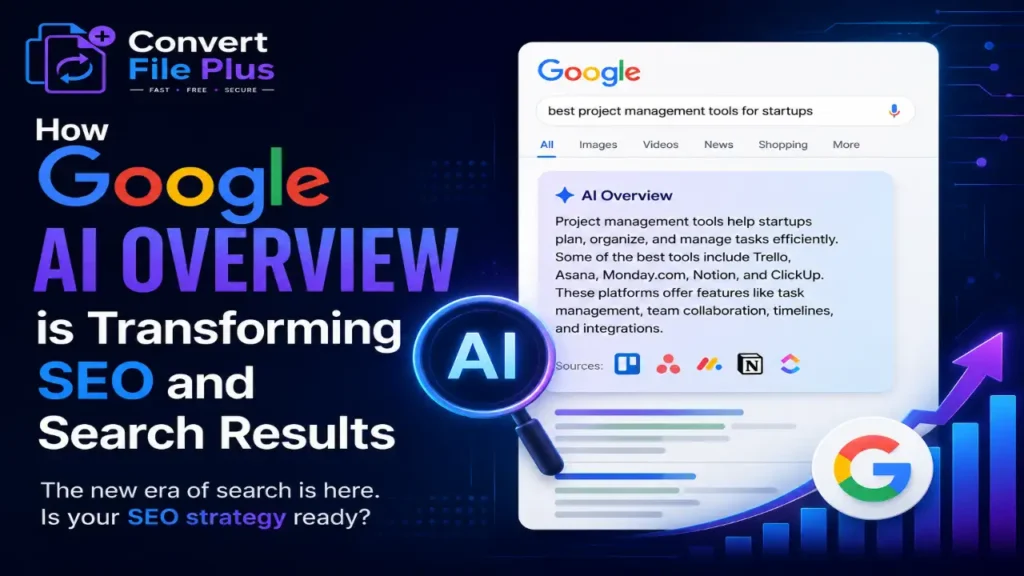
Google AI Overview transforming SEO and search results with AI-generated answers replacing traditional search listings.
Digital Marketing & Social Media

How Google AI Overview Is Transforming SEO and Search Results

Introduction Search used to be simple. You typed something, Google showed you ten blue links, and you clicked through to find what you needed. That model worked well for nearly two decades. But over the past year, something has shifted  quietly at first, then all at once. Google’s AI Overview feature (formerly called Search Generative Experience) is now live for hundreds of millions of users across the U.S. and beyond. According to third-party SEO studies, AI Overviews are appearing in roughly 25% of all Google search queries. A 2024 BrightEdge report found that AI-generated summaries now appear above traditional organic results in a significant share of informational searches  meaning the click never happens at all. That last part is worth sitting with. If users are getting their answers directly on the search results page, what happens to the websites that used to capture that traffic? And more importantly, what does that mean for founders, marketers, and business owners who’ve spent years building organic search as a core growth channel? This is not a reason to panic. But it is a reason to pay attention  especially before the broader rollout that industry analysts expect to mature significantly by 2028–2030. Read Also : GEO vs SEO: How AI Search Optimization Tools Increase Organic Traffic Beyond Google Rankings What Exactly Is Google AI Overview? Google AI Overview is essentially a large language model-powered answer box that appears at the top of search results. When someone searches a question like “how do I reduce churn for a SaaS business,” Google doesn’t just list websites anymore  it synthesizes an answer using content from across the web and presents it directly on the page. Think of it as Google doing the reading for the user. It pulls from multiple sources, cites them (usually), and delivers a structured summary before the user ever scrolls to the organic listings below. For certain query types  how-to guides, definitions, comparison questions  this can effectively remove the need to click through to a source at all. It’s a significant change in how information flows between publishers and readers. Why This Changes the SEO Equation Traffic Patterns Are Already Shifting The clearest impact is on what marketers call “informational queries”  the top-of-funnel searches that brands have used for years to build awareness and drive blog traffic. These are the first to get absorbed by AI Overviews. Early data from publishers and SEO platforms like Semrush and Ahrefs suggests that click-through rates on informational queries have declined in searches where AI Overviews appear. The exact drop varies by industry and query type, but the directional trend is consistent: when Google answers the question on-page, fewer users click through to the source. That creates a real tension for content-heavy businesses  the very articles they’ve invested in creating are now being used to train and feed an AI that reduces the need to visit their site. Transactional Queries Are (For Now) More Protected Here’s the nuance that often gets lost: not all search traffic is equally affected. Transactional queries  “buy running shoes online,” “SaaS project management tool pricing,” “book a hotel in Jaipur”  still tend to generate clicks because the user needs to take an action that Google can’t complete for them. The same goes for highly specific, niche, or localized queries. If someone is searching for a very particular product, a local service, or a recent event, AI Overviews tend to be less complete, and users still click through. For now, the closer a query is to a purchase decision or a specific human need, the less disruption businesses are likely to feel. What Businesses Are Getting Wrong About This Treating It Like a Search Algorithm Update Most major algorithm updates  Panda, Penguin, Helpful Content  required adjustments to existing strategies. Publishers cleaned up thin content, fixed technical issues, and recovered over time. AI Overview is different. It’s not a ranking change. It’s a structural shift in how Google uses content. Businesses that respond by simply “optimizing for AI Overview”  chasing featured snippets, adding FAQ sections  are solving the wrong problem. The deeper question is: what is your content actually for? If it exists purely to rank and funnel traffic to a landing page, that model is under pressure. If it exists to demonstrate genuine expertise, build trust with an audience, and support a broader relationship with readers  that still has long-term value, even if the traffic numbers look different. Ignoring Brand and Authority Signals Google’s AI Overview doesn’t cite randomly. It tends to pull from sources that have established credibility in their domain  authoritative domains, frequently cited sources, and content that aligns with E-E-A-T (Experience, Expertise, Authoritativeness, Trustworthiness) principles. This means that brand building, thought leadership, and genuine subject matter depth are now more directly connected to search visibility than ever before. Being cited inside an AI Overview is effectively a new form of organic reach  even if it doesn’t always generate a click. What This Means for Different Types of Businesses For publishers and content-heavy brands: The immediate impact is real. Traffic from broad informational queries is declining for many. The response isn’t to produce less content  it’s to produce content that requires human judgment, experience, and specificity that AI can’t easily replicate. Firsthand research, original data, expert interviews, and case studies become more valuable, not less. For e-commerce and product businesses: The risk is lower in the near term. Focus on product page depth, reviews, structured data, and ensuring your brand appears in queries where users are ready to buy. Build a strong enough brand that users search for you directly. For service businesses and B2B companies: Your audience is often searching with high intent. Ensure your expertise is visible across authoritative platforms, build relationships that generate backlinks from trusted sources, and invest in content that speaks to specific pain points your buyers actually have. For local businesses: Local search results are still largely driven by Google Business Profile, proximity, and reviews. AI Overview has limited impact on “near me” queries

GEO vs SEO showing how AI search optimization tools increase organic traffic
AI & Machine Learning, Digital Marketing & Social Media

GEO vs SEO: How AI Search Optimization Tools Increase Organic Traffic Beyond Google Rankings

Introduction Let’s be honest—search is not the same anymore. A few years ago, SEO was simple. You write content, add keywords, build some links, and if you rank on Google, you get traffic. Done. But now, things are changing very fast. People are searching using AI chat tools, voice search, and AI-generated answers. Even Google is showing AI answers directly on the search page. That’s why many website owners are confused today. They ask one big question again and again: how ai search optimization tools increase organic traffic when clicks are becoming harder? In this blog, I will explain everything in a clean and easy way. GEO vs SEO, and how AI tools can help you grow traffic beyond Google rankings. Read Also : Future of SEO in 2026: How AI Is Changing Search Behavior What is SEO? (The Old but Still Important Game) SEO means Search Engine Optimization. It is the process of optimizing your website so it ranks higher on search engines like Google and Bing. When you rank higher, more people click your page. More clicks means more organic traffic. That is the traditional SEO model. SEO is still important in 2026. But today, SEO is not only about ranking—it is also about trust, clarity, and being the best answer. What is GEO? (The New Search Reality) GEO means Generative Engine Optimization. It focuses on optimizing content for AI-based answer engines and generative search results. Today, AI systems read multiple pages and create a short answer. Many users read that answer and leave without clicking any website. So GEO is about making your content easy for AI to understand and use. When AI tools use your content in their answers, your visibility grows even without direct rankings. GEO vs SEO (Main Differences in Simple Words) SEO focuses on search engines like Google. GEO focuses on AI engines and AI answer systems. In SEO, the goal is to rank in search results. In GEO, the goal is to be included in AI answers and summaries. SEO brings traffic mostly from clicks. GEO brings traffic from brand trust, mentions, and future searches when users remember your name. Why Organic Traffic is Changing in 2026 (The Real Reason) One big reason organic traffic is changing is zero-click search. This means users get answers directly on the search page and do not click any website. AI Overviews and chat-based search are making this trend bigger. Users want quick answers, not long browsing. This is why we must think beyond Google clicks. We must learn how ai search optimization tools increase organic traffic across different search platforms. How AI Search Optimization Tools Increase Organic Traffic (The Core Idea) AI tools help you in research, planning, writing, and optimization. They remove guesswork from SEO and give you clear direction. They also help you write in a way that is easy for AI engines to read and quote. That is a big part of GEO. So when you use them correctly, how ai search optimization tools increase organic traffic becomes very practical, not theoretical. AI SEO Tools for Organic Traffic (Why They Matter) AI SEO tools for organic traffic help you find keywords faster and understand what users actually want. They also help you create better content structure, better headings, and better topic coverage. These factors increase rankings naturally. And when content quality improves, it performs better not just on Google but also inside AI answers. That is why these tools matter in 2026. How AI Improves Search Rankings (Without Tricks) Many people think AI improves rankings by keyword stuffing. But real SEO does not work like that anymore. how AI improves search rankings is mainly through better relevance and better user experience. AI tools help you match search intent properly. They also help you remove weak sections, add missing points, and improve flow. When your content feels complete, rankings improve automatically. AI Helps You Understand Search Intent Better Search intent means what the user really wants. Some users want a definition, some want steps, and some want tool lists. AI tools can analyze top-ranking pages and tell you what the common structure is. This helps you create content that matches Google’s expectations. That is one strong reason how AI improves search rankings in a smart and safe way. AI Helps Improve Content Readability Readability is very important today. People do not like long blocks of text. AI tools help you write short sentences and short paragraphs. This increases time-on-page and reduces bounce rate. When users stay longer, Google considers your content helpful. That is another reason how AI improves search rankings. AI-Powered Keyword Research Tools (The Smart Keyword System) AI-powered keyword research tools do not only give keywords. They give you keyword clusters, intent groups, and question-style queries. This helps you plan content in a better way. Instead of writing random points, you build a full topic map. This topic map helps your website become an authority. And authority is one of the biggest ranking factors in modern SEO. Long-Tail Keywords Bring the Best Organic Traffic Long-tail keywords are longer and more specific. They usually have lower competition and higher conversion. For example, instead of “AI SEO tools”, you can target how ai search optimization tools increase organic traffic. These keywords bring visitors who are serious and need exact answers. That is why long-tail strategy works very well in 2026. Keyword Clustering Helps SEO and GEO Together Keyword clustering means grouping similar keywords under one topic. This helps you create strong H2 and H3 headings. AI loves structured content, and Google also loves structured content. So clustering supports both GEO and SEO. This is a big reason how ai search optimization tools increase organic traffic beyond rankings. AI Content Optimization for SEO (This is Where Most People Fail) AI content optimization for SEO is not about writing content using AI and publishing it directly. It is about improving your human-written content with AI support. AI tools can tell you what parts are missing and what should be improved. When you optimize content, you increase its quality and depth. That is

Futuristic illustration showing Instagram Algorithm in 2026 with AI brain, smartphone analytics graph, and engagement metrics like saves and shares
Digital Marketing & Social Media

Instagram Algorithm in 2026: The Real Truth Behind Reach (And How to Win It)

Instagram Algorithm… a Word That Instantly Changes a Creator’s Mood Instagram algorithm… just hearing this word can change a creator’s mood instantly Sometimes it feels like, “Guys my reach is dead,” and sometimes it feels like, “today the algorithm is literally my best friend.” But honestly? In 2026, the Instagram algorithm has become smarter and kind of moody too. It’s like… Instagram doesn’t blindly push content anymore. Now it checks one thing very seriously: “Do people genuinely like this content… or is the creator just posting for the sake of posting?” And this is exactly where many creators fail. In this blog, I’ll explain everything in super simple language: So let’s go — no unnecessary talk, straight into breaking the algorithm 😄 Instagram Algorithm in 2026: Does the Algorithm Really “Punish” You? First, let’s clear this myth. Instagram algorithm doesn’t punish you.Instagram algorithm predicts. Meaning Instagram tries to guess for every post: If Instagram gets strong positive signals, it pushes the post further.If signals are weak, the post quietly gets buried. Read Also : Why a Strong Social Media Presence Is Important for Every Business How Instagram Algorithm Works 2026 (Real Working Explained) Now let me explain how instagram algorithm works 2026 in a true “insider” style. In 2026, Instagram algorithm works in 3 stages: 1) First Testing Phase (Initial Push) The moment you post (Reel, carousel, or photo), Instagram first: Important: In 2026, the first hour plays a massive role. If people: then Instagram says: “Okay this content is good… let’s show it to more people.” 2) Expansion Phase (Reach Boost) If the first group gives good signals, then your content starts getting distributed to: And this is where organic growth begins. 3) Long Tail Reach (Evergreen Push) This stage has become even stronger in 2026. You must have noticed this: Sometimes a reel stays dead for 2 days… then suddenly on the 3rd day it gets 10k views 😳 This happens because Instagram tests the content again with new audiences. Conclusion: Instagram Algorithm in 2026 is not instant. It can be delayed. Instagram Algorithm in 2026’s Biggest Secret: “Retention” In 2026, the most powerful ranking signal is: ✅ Watch time + Retention Meaning how long people are watching your reel. Instagram just wants one thing: “Are people staying on the app or not?” That’s why creators who only focus on “pretty editing” sometimes fail. Because even without heavy editing, retention can be created — if the hook is strong. Increase Instagram Reach Organically: The Real Formula Right Now Now let’s talk about increase instagram reach organically. Reach increases only when you give Instagram the correct signals. The real formula of organic reach: ✅ Right content type✅ Right audience match✅ Right engagement triggers✅ Right consistency Now let’s break it into easy points.  Increase Instagram Reach Organically Using “Audience Match Content” Instagram algorithm in 2026 has become more personal. Now it analyzes audience interest like: So what do you need to do? Don’t create content for “everyone”…Create content for your audience. Example: If you are a digital marketing creator, your reels structure should include: And yes… if you suddenly post a “random motivational reel” in between, confusion starts. Algorithm literally says: “What is this account even about?” 😵‍💫  Use One Clear Content Pillar (2026 Trick) In 2026, algorithm loves clarity. 70% of your page should focus on one core topic. For example: Then algorithm can easily classify: “Okay, this creator’s audience is this.” And your reach stays stable. Instagram Engagement Tips 2026: Not Likes… “Saves + Shares” Matter This is where most people go wrong. They think: “If I get likes, I will get reach.” The main rule of instagram engagement tips 2026: ✅ Saves > Shares > Comments > Likes Likes are easy.Saves and shares are difficult.That’s why algorithm gives saves/shares more value. How to Create Engagement Triggers? These days, the best engagement triggers are: But the problem comes when it sounds unnatural. So the best method is: End your reel with 1 natural line: “Save it… you’ll need this later.” That’s it. Simple. Instagram Reels Reach Strategy 2026: Hook is King If you are focusing on reels, listen carefully: instagram reels reach strategy 2026 = Hook + Retention + Shareability Hook (First 1–2 seconds) People scroll super fast. If your first line is boring: Hook examples: Human tone makes hooks stronger. Retention (Make It Watchable) Simple structure: Shareability (Make It Relatable) In 2026, reels survive only when people share them. Best shareable content types: Best Time to Post on Instagram 2026: Is It Still Important? Now the popular question: best time to post on instagram 2026 — what is it? My honest answer? Time matters… but it’s not everything. In 2026, Instagram algorithm uses delayed distribution.Meaning even if the post doesn’t explode instantly, Instagram still tests it. So why is best time still important? Because the first hour signals matter. If you post when your audience is online: Best Time to Post on Instagram 2026 (Practical Slots) These are general slots that work well for India-based audiences: But the best method to find your real best time: Insights → Audience → Most Active Times Instagram Algorithm in 2026: New Ranking Signals (Updated) Now let me share updated ranking signals that matter more in 2026: 1) Content originality Instagram can easily detect copied content now. Result: reach cut. 2) Consistent topic + niche As I said: Algorithm loves “clear identity”. 3) Profile trust signals This one is underrated. Instagram checks: If profile looks suspicious: 4) Interaction history If someone regularly watches/comments on your reels, Instagram shows your future content to them faster. That’s why community building is the real base of reach. Instagram Algorithm in 2026: How to Win the Reach Game In Part 1, we understood: Now in Part 2, I’m sharing the things most people don’t clearly explain — and this is what helps you train the algorithm in your favor. How to “Train” the Instagram Algorithm in 2026? (Yes, You Can) Instagram algorithm is not a human… but it behaves like one.If you repeatedly post one type of content, the algorithm slowly understands:

Future of SEO in 2026 showing how AI-powered search engines and generative AI are changing search rankings
Digital Marketing & Social Media

The Future of SEO in 2026: How AI Is Changing Search

Introduction: SEO Is Not Dead, It’s Just Growing Up Let me say this clearly first — SEO is not dying.But yes, the SEO we knew five years ago is gone. If you’re still thinking SEO is only about keywords, backlinks, and ranking on page one, then honestly, you’re already behind. In 2026, search looks very different. Users search differently. Google understands differently. And content is judged in a much deeper way. The Future of SEO in 2026 is not about tricks or shortcuts. It’s about understanding people, intent, and how AI-powered systems read and rank content. AI is not replacing SEO. It is reshaping it. And if you’re a blogger, SEO professional, or website owner, this change is something you must understand — not tomorrow, but today. Understanding the Future of SEO in 2026 The Future of SEO in 2026 is strongly connected to how artificial intelligence interprets human behavior. Search engines are no longer machines matching words. They are systems trying to understand meaning. Today, search engines analyze: This shift changes everything. SEO in 2026 is more about clarity, depth, and usefulness. Content that feels written for humans, not algorithms, performs better. That’s not a theory anymore — it’s happening already. Shortcuts may give temporary visibility, but long-term rankings belong to content that genuinely answers questions. AI-Powered Search Engines and the New Search Experience What Are AI-Powered Search Engines? AI-powered search engines are systems that use machine learning, natural language processing, and predictive understanding to deliver answers — not just results. Instead of showing ten blue links, these engines try to: This is a big shift in the Future of SEO in 2026. Users are no longer clicking multiple pages. They expect clear, direct, and trustworthy answers. That means your content must be structured in a way that AI can understand easily. How AI-Powered Search Engines Change SEO With AI-powered search engines, ranking is no longer just about being first. It’s about being useful enough to be referenced. SEO now depends on: If content feels confusing or forced, AI systems simply ignore it. This is why conversational, human-style writing performs better in modern search. Search Intent Optimization Is the Real SEO Skill Now Why Search Intent Optimization Matters More Than Keywords Let’s be honest — stuffing keywords never worked long-term.And in 2026, it works even less. Search intent optimization means understanding why someone searches something, not just what they type. For example: The Future of SEO in 2026 depends heavily on matching content with intent, not keyword count. If your content answers the wrong question, it won’t rank — even if it’s perfectly optimized. How to Apply Search Intent Optimization Correctly To improve search intent optimization, content must: When content tries to satisfy everyone, it satisfies no one. Clear intent wins. Google AI Algorithms Are Smarter Than Ever How Google AI Algorithms Evaluate Content Google AI algorithms no longer scan pages line by line like before. They evaluate content holistically. They analyze: This means thin content struggles to survive. The Future of SEO in 2026 favors content that feels complete — not perfect, but complete. Human-style imperfections are acceptable. Lack of clarity is not. What Google AI Algorithms Want in 2026 Google AI algorithms prefer: This is why writing like a human actually helps SEO now. SEO for Generative AI Search Results What Is SEO for Generative AI? SEO for generative AI focuses on optimizing content so it can be used in AI-generated answers, summaries, and search previews. In 2026, many users don’t even visit websites. They read AI-generated responses directly on search pages. That sounds scary, but it’s also an opportunity. If your content is clear and structured, AI systems may use your explanation as the reference. That visibility still builds trust and authority. How SEO for Generative AI Works For effective SEO for generative AI, content must: The Future of SEO in 2026 is not about ranking alone. It’s about being recognized as a reliable source. Future SEO Strategies That Actually Make Sense Why Old SEO Strategies Are Fading Let’s be honest again — many SEO strategies taught today won’t work tomorrow. Buying links blindly, spinning content, or chasing algorithms is risky. AI systems adapt faster than humans. The Future of SEO in 2026 rewards patience and quality. Short-term hacks may still exist, but they don’t last. Core Future SEO Strategies to Focus On Effective future SEO strategies include: SEO now feels more like teaching than selling. And honestly, that’s a good thing. Why the Future of SEO in 2026 Is More Human Than Ever This might sound ironic, but AI is pushing SEO to become more human. Why? Because AI understands humans better than keyword lists. The Future of SEO in 2026 values: Perfect grammar is less important than clear thinking. And content that sounds like a real person talking usually wins. How Content Structure Will Decide SEO Success in 2026 In the Future of SEO in 2026, content structure is no longer a “nice to have” thing. It’s mandatory. You can write amazing thoughts, but if your content feels messy, AI systems struggle to understand it. And when AI struggles, rankings struggle too. Search engines now prefer content that feels: That’s why headings, subheadings, and short paragraphs matter more than ever. Why Proper Headings Matter in the Future of SEO in 2026 Headings are not just for design anymore. They guide AI. When you use: You’re basically telling search engines, “Here’s what this page is about.” This improves visibility not only in normal search results but also in AI-powered search engines and generative answers. Writing Style That Works With AI, Not Against It Let me be very honest here. If you try to write like a robot to please AI, it backfires. The Future of SEO in 2026 clearly shows that AI prefers content that sounds natural. Slightly uneven sentences. Real explanations. Human pauses. Content that feels too polished often feels artificial. What a Human SEO Writing Style Looks Like Human-friendly SEO writing includes: You don’t need fancy words. You need clarity. This style helps with: And all of this indirectly supports rankings. Search Intent Optimization Will Separate Winners From Losers Let’s talk more deeply about search intent optimization, because this is where most people still fail.

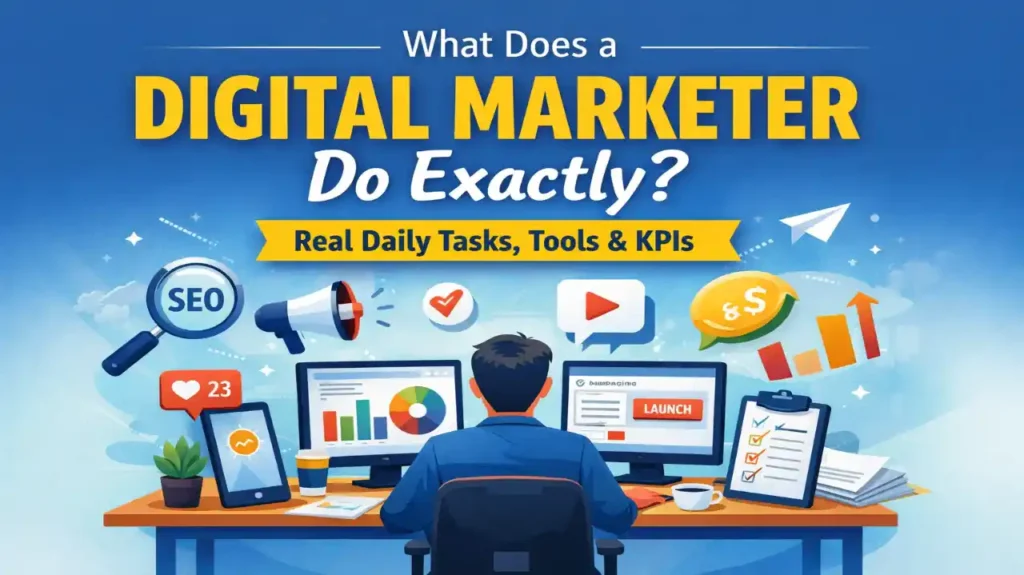
What does a digital marketer do exactly showing real daily tasks tools and KPIs on a work desk
Digital Marketing & Social Media

What Does a Digital Marketer Do Exactly? (Real Daily Tasks, Tools, and KPIs)

Introduction: Let’s Clear the Confusion First If you search online for what does a Digital Marketer do exactly?, most answers feel vague.Some say “they promote brands online.”Some say “they handle social media and ads.” But honestly, that doesn’t help much. Because if you’re a student, a business owner, or someone planning a career shift, the real question is simple: What does a digital marketer actually do every day?What kind of work fills their screen from morning to evening? That’s exactly what we’ll talk about here — no hype, no buzzwords.Just real work, real tasks, and real expectations. Understanding What a Digital Marketer Does (In Simple Words) Before diving into tools and dashboards, let’s slow down a bit. A digital marketer is not someone who does everything online.And they are definitely not just “posting reels” or “running ads.” At the core, a digital marketer’s job is this: To bring the right people to a product or service, at the right time, and measure what actually worked. That’s it. Everything else — SEO, ads, content, email, analytics — supports this single goal. What Does a Digital Marketer Do Exactly? (The Big Picture) If I had to explain what does a Digital Marketer do exactly? in one honest line, it would be this: A digital marketer plans, executes, tracks, and improves online campaigns that drive traffic, leads, or sales. But let’s break that down properly. A digital marketer usually works in four major phases: Each phase involves specific work, not theory. Read Also : How to Learn Digital marketing Course Digital Marketer Roles and Responsibilities (Core Breakdown) This is where most articles stay surface-level.So let’s be clear and practical. 1. Understanding Business or Client Goals Before touching any tool, a digital marketer needs clarity. They ask questions like: Without this clarity, marketing becomes guesswork. This responsibility alone decides whether campaigns succeed or fail. 2. Planning the Digital Marketing Strategy Once goals are clear, planning begins. This includes deciding: This is a thinking-heavy phase.Good digital marketers spend more time here than people realize. 3. Executing Campaigns Across Channels Now comes action. Execution means: This is where digital marketing daily tasks start showing up clearly. 4. Tracking Performance and Making Improvements This is the most ignored but most important part. A digital marketer constantly checks: Based on data, they tweak campaigns again and again. What Does a Digital Marketing Job Involve on a Daily Basis? Let’s get more specific. People often imagine digital marketing as “creative work only.”In reality, it’s a mix of analysis, execution, and problem-solving. Here’s what a normal workday often includes. Digital Marketing Daily Tasks (Real, Practical View) 1. Checking Analytics and Performance Data Most digital marketers start their day with data. They look at: This helps them understand what changed overnight. Small changes matter a lot here. 2. Content Review and Optimization Content is rarely “done forever.” Daily tasks include: This is silent work, but it brings long-term results. 3. SEO Monitoring and Improvements SEO is not a one-time task. Daily or weekly work includes: This is where patience is tested. 4. Managing Paid Ads (If Applicable) For performance marketers, ads are daily responsibility. They: One wrong setting can waste money fast. 5. Coordination with Team Members Digital marketers rarely work alone. They communicate with: Clear communication saves hours of confusion later. Tools a Digital Marketer Uses (No Fancy Names, Just Reality) Tools don’t make someone a marketer, but they support the work. A digital marketer usually works with: Learning tools is easy.Understanding why to use them is what matters. KPIs a Digital Marketer Tracks (This Is Where Truth Shows) Here’s something important. A digital marketer is judged by numbers, not effort. Some common KPIs include: Good marketers don’t panic with bad numbers.They investigate them. Different Types of Digital Marketers (Not Everyone Does Everything) Another big misconception. Not every digital marketer handles all channels. Some common roles include: Understanding this avoids unrealistic expectations. Skills That Matter More Than Certifications This part is often ignored. What really matters: Tools and platforms change.These skills don’t. Common Myths About Digital Marketing Work Let’s quickly clear a few myths. Digital marketing rewards consistency, not shortcuts. Why People Still Ask: What Does a Digital Marketer Do Exactly? Because job titles are confusing. Two digital marketers can have completely different days, depending on: That’s why generic answers never feel satisfying. Important Transition Thought Now that you understand the core responsibilities, daily tasks, tools, and KPIs, the next part will go deeper into: I’ll continue this naturally, without repeating fluff. A Real Day in the Life of a Digital Marketer (Beginner vs Experienced) To truly understand what does a Digital Marketer do exactly?, you have to see how the work changes with experience. Because the job looks very different at different stages. Beginner Digital Marketer: How the Day Usually Looks A beginner spends most of the day learning by doing. Typical daily tasks include: At this stage, mistakes happen.And honestly, that’s normal. The goal is not perfection, but understanding why something worked or didn’t. Experienced Digital Marketer: A Very Different Routine With experience, the job shifts. Daily work involves: Less execution, more thinking. This is where digital marketing becomes strategic, not mechanical. How Digital Marketers Decide What to Work on First This is something no one explains properly. A digital marketer does not do tasks randomly.Priority usually depends on: For example: This decision-making skill separates average marketers from good ones. Digital Marketer Roles and Responsibilities Change by Industry The same job title behaves differently everywhere. In a Startup In an Agency And in a Corporate Company So when someone asks what does a digital marketing job involve, the honest answer is:it depends on where you work. How Digital Marketers Measure Success (Beyond Vanity Metrics) Likes and views look nice.But they don’t pay salaries. Real success is measured using: A digital marketer constantly asks:“Is this bringing meaningful results or just noise?” That mindset matters more than any tool. The Thinking Process Behind Every Digital Marketing Action This is subtle but important. Before doing any task, a good digital marketer thinks: Without this thinking, marketing becomes random posting.

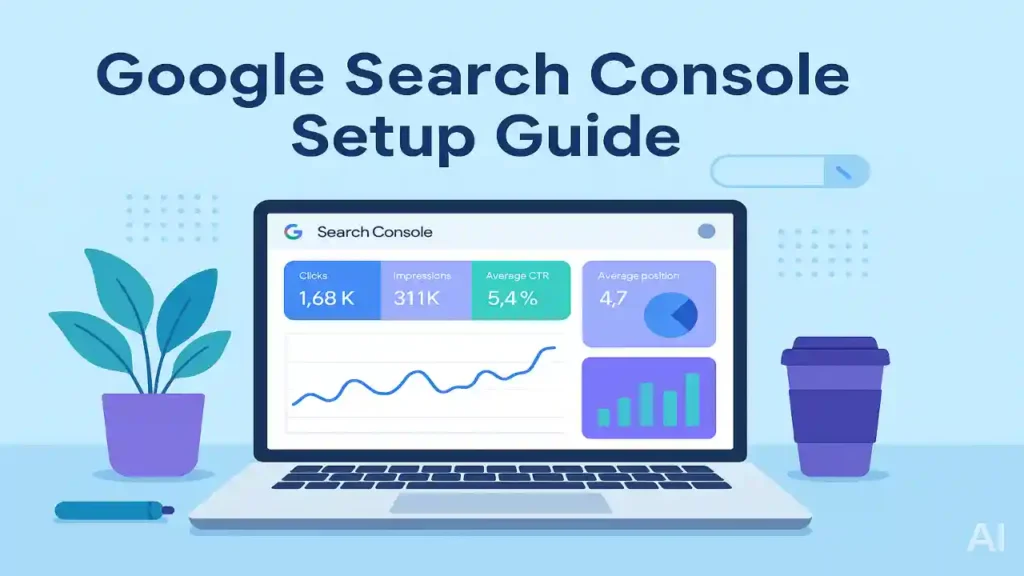
What is the Google Search Console used for dashboard illustration
Digital Marketing & Social Media

What Is the Google Search Console Used For? 15 Real Examples Every Website Owner Should Know

Honestly, if you run anything online — a small blog, a business site, or even a tools website — there comes a moment when you think, “How does Google know if my website is working properly or not?”This is exactly where Google Search Console starts helping you. In this blog, I am sharing everything that I personally use. In simple words, without any promotion — just like a normal person talks. And yes, we will use the main focus keyword “What is the Google Search Console used for?” naturally throughout the blog. Let’s start. Google Search Console actually works like the backbone of digital marketing— the better insights you get, the stronger your overall digital marketing performance becomes. Read Also : Best Digital Marketing Tools in India Everything You Need to Know About Digital Marketing Courses, Jobs, and Salary in 2025 What Is the Google Search Console Used For? (A Simple Human Explanation) First thing — Google Search Console (GSC) is a free tool from Google that shows how your website is performing on Google Search. Think of Google Search Console as a health report, a performance tracker, and a problem detector — all in one place. If you want to understand What is the Google Search Console used for?, here is the short answer: But I don’t want to only talk in theory.So I will explain everything using 15 real examples — in a simple human tone. Google Search Console Setup Guide (Secondary Keyword) Most people feel confused here, but setting it up is actually very easy.Just follow this simple Google Search Console setup guide: Step 1 — Go to the Google Search Console Website Login with your Google account. That’s it. Step 2 — Add Your Property You will see two options: If you are a beginner, URL Prefix is easier. Step 3 — Verify Ownership Ways to verify: I personally prefer the HTML Tag method — it’s simple and fast. Step 4 — Add Your Sitemap This part is very important (we will talk more about it later). Once this is done, your setup is complete.Now you are ready to see how Google views your website. How to Submit Sitemap in Google Search Console Your second secondary keyword also fits naturally here. Submitting a sitemap means you are giving Google a clean list of all your important pages.This helps Google crawl your site faster and more accurately. Step 1 — Find Your Sitemap URL Most websites have a sitemap like: If you use WordPress, Rank Math or Yoast creates it automatically. Step 2 — Open Google Search Console On the left side menu, you will see the “Sitemaps” option. Step 3 — Enter Your Sitemap URL Paste the URL → click submit. Google gets your sitemap, Google understands your site better. And your crawling, indexing, and ranking journey begins. Real-Life Use Cases: What Is the Google Search Console Used For? (15 Examples) Now I am sharing all 15 examples that will help you fully understand What is the Google Search Console used for? 1. Check Website Performance (Clicks, Impressions, CTR) I personally check this daily.You can see: If you ever think “how to check website performance on Google,” the answer is GSC. 2. See Keyword Queries (Actual Search Terms) This is one of the strongest features in GSC.You can see: This can change your whole content strategy. 3. Find Indexing Issues Sometimes a page simply doesn’t get indexed.Reasons: GSC directly tells you — “this page is not indexed, fix it.” 4. URL Inspection Tool This is my favourite tool.For any URL, you can check: If the page is not indexed, you can also request indexing. 5. Check Mobile Usability Today’s world is mobile-first.GSC shows: Fix these issues → ranking improves. 6. Check Core Web Vitals Core Web Vitals are a direct ranking factor.GSC tells you: And which pages “need improvement.” 7. Coverage Report It shows: Everything is clearly visible. 8. Manual Actions If Google ever gives your site a penalty, it appears here.It’s rare, but it can happen. 9. Sitemap Status You can check if your sitemap pages are being indexed or not. 10. Backlinks Check This feature is very useful.GSC shows: It’s a free backlink checker with real Google data. 11. Internal Links Report Internal links help improve ranking.Here, you can see which pages have strong internal links. 12. Removals Tool If you want to temporarily remove a page from Google,you can request it here. 13. Crawled but Not Indexed Issues This is very common.Google crawls your page but doesn’t index it. Reasons: GSC tells you the exact reason. 14. Monitor Fresh Content You can see when your new page got indexedand which keywords it started ranking for. 15. Performance Comparison You can compare: It shows if your work is helping or not. Benefits of Google Search Console (Clear and Practical) After doing all this, what benefits do you get? And the biggest benefit —Google understands your website better. Conclusion So finally, if I say in one line What is the Google Search Console used for? Simple answer: “Google Search Console shows the real truth of what is happening with your website inside Google.” GSC clearly tells you —where the problem is,where the improvement is,and where the growth is. Today, any website owner, blogger, marketer, or business is working blindly without GSC. In this blog, I shared 15 real examples to help you understand everything clearly.If you check GSC daily, your website grows automatically —you just need to analyse the right things and improve the right pages. FAQs

why social media presence is important for business
Digital Marketing & Social Media

Why a Strong Social Media Presence Is Important for Every Business

These days, honestly speaking, if your business is not on social media, people don’t even realize you exist.Simple truth — earlier, people used to visit shops, but now they just open their phones.They search, scroll, and decide right there what to buy and from where. That’s why I always say — why social media presence is important for business — because it’s the new-age “storefront.”People look at your social media page and make their first impression there.And if that first impression goes wrong, then that’s it — game over. Read Also : 5 Major Disadvantages of Digital Marketing (and How to Fix Them in 2025) 1. Understand the Real Meaning of Social Media Marketing See, most people think social media marketing means just posting one photo every day and that’s it — job done.But honestly, it’s not that simple.It’s not just about pictures or posts — it’s actually your brand’s “personality.” The importance of social media marketing is that it helps you connect with people.Your business grows only when people trust you.And that trust comes from daily interactions, those small posts, and replying to comments. Being active on social media means being among people — and that’s where everything begins, right? 2. Benefits of Social Media for Business Now if we talk about the benefits of social media for business, the list is long — but I’ll explain it simply: All these small things together help your business grow.Social media is no longer a luxury — it has become a necessity. 3. Social Media Strategy for Small Businesses Now let’s talk about small companies — like a local bakery, boutique, or freelancer.Many people think, “Oh, we’re a small business, we can’t do all this.”But honestly, social media strategy for small businesses is the most powerful one. Because small businesses have that personal touch — that real feeling.Here’s what you need to do: Imagine you run a bakery.Post a reel every week of a cake you made, show a little behind-the-scenes, and reply to comments with a funny touch — trust me, people will get hooked to your brand. 4. How to Build a Strong Social Media Presence Now, everyone has this question — “Okay, I get it… but how do I actually do it?”So let’s talk step-by-step — how to build a strong social media presence: Just remember — people don’t connect with “perfect” brands, they connect with real ones. 5. Some Social Media Presence Examples Now let’s look at some examples — so you can see how different brands built their image: Got it? All these brands are simply real.That’s the reason their social media presence is so strong. 6. Why Social Media Presence Is Important for Business Growth Let’s come back to our main keyword —why social media presence is important for business? Simple — because it’s not a shortcut to growth, it’s the foundation.Every post, every story, every reply — all of it builds trust over time. And when people trust you, they buy from you, recommend you, and come back again.Think about it — how can any brand grow today without social media when the whole audience is online? 7. The Future of Social Media – Staying Real Look, AI, trends, and new platforms will keep coming.But one thing will never change — people always want something real. That means, the more authentic you are, the more you’ll grow.Algorithms will keep changing, but emotions and human connections never go out of trend. Conclusion: Stay Real, Stay Consistent, Stay Connected At the end, I’ll just say one thing —Social media is not a “show-off” tool, it’s a connection tool. The more real and honest your brand is, the more people will connect with it.And that connection will one day turn into business growth. So don’t overthink it. Start simple. Post what feels right. Engage like a human — not like a company.Because in the end, social media presence is important for business not just so people see you,but so they understand — that your brand is human, just like them. FAQs

What Are 5 Disadvantages of Digital Marketing?
Digital Marketing & Social Media

5 Major Disadvantages of Digital Marketing (and How to Fix Them in 2025)

Introduction These days, digital marketing is everywhere.Some people are growing their Instagram handles, some are running Google Ads, and others are busy with SEO.It all looks cool from the outside — “Grow your business through online marketing!”But honestly, digital marketing also has its own disadvantages that people don’t talk about much. So let’s come straight to the point —I’ll tell you the 5 major disadvantages of digital marketing,and also how you can handle these problems smartly in 2025. Read Also : Best Digital Marketing Tools in India 1. Too Much Competition — Sometimes It Gets Demotivating The biggest disadvantage of digital marketing is too much competition.Almost every field already has people posting content, running ads, and grabbing audience attention.Whether you’re in fashion, tech, or fitness — the market is full of crowd. Why does this happen?Simple — because everyone has the internet.Today, anyone can run an ad, write a blog, or upload a YouTube video from their phone.Result — the market is overloaded. How to Fix It: Here, smartness matters more than anything.First, stop trying to target everyone — choose a specific audience.Then focus on their pain points and real problems.Use storytelling, not just boring ads.And yes, don’t ignore SEO — understand the right keywords and intent before you write.That’s how you’ll stand out in the crowd. 2. Algorithms Keep Changing and We Keep Getting Confused (Secondary Keyword: Major Limitations of Digital Marketing You Should Know) Honestly, this is the most irritating part.Today Instagram works one way, tomorrow it changes.Google brings an update, and suddenly your ranking disappears. This is one of the major limitations of digital marketing — nothing is permanent.What worked last month might not work today. How to Fix It: 3. It Takes Time and Money — You Need Patience, Bro Many people think digital marketing is free — just post something on social media and money will come.Reality check: that’s not true Digital marketing needs consistent investment — whether it’s ads, tools, or your time. Sometimes it feels like you’re doing everything right, but results are still slow.And that’s one big challenge in digital marketing — without patience, it’s hard to survive. How to Fix It: Be smart, not overworked. 4. Handling Negative Comments and Feedback Is Tough ( Common Challenges Faced in Digital Marketing Campaigns) This is one of the most common challenges faced in digital marketing campaigns —public criticism.No matter what you post, someone won’t like it.One comment says, “This is fake,” or “Worst product ever,” and your mood drops instantly 😑 How to Fix It: See Anand, negativity will always come — but if you handle it smartly, that feedback can become your strength. 5. Overdependence on Technology — Sometimes the System Fails This is probably the most frustrating part. Digital marketing runs completely on technology —one tool fails, the whole system goes down. The website crashes, the campaign stops.Analytics glitch happens, and your data disappears. How to Fix It: Technology is important, but the human brain is stronger — strategy is still the biggest tool. Bonus: Don’t Automate Everything — Human Touch Is Important We’re living in an age of AI and automation.But the truth is — automation can’t replace emotion.People buy emotions, not ads.So even if you use AI or chatbots, keep your tone human.Add some humor, some story, and a little bit of heart — that’s what makes you different. Conclusion Now you know,What are 5 disadvantages of digital marketing?Let’s do a quick recap 👇 But honestly — every disadvantage has a hidden lesson.If you understand what to fix and how,digital marketing can still be your best growth tool. Just stay consistent, stay updated, and keep your human touch alive.Because in 2025, the brand that feels real — not robotic — will win. FAQs for: What Are 5 Disadvantages of Digital Marketing

What Are the 5 Steps of Email Marketing?
Digital Marketing & Social Media

5 Proven Steps of Email Marketing That Actually Work in 2025 (With Real Examples)

Has it ever happened, Guys, that you wrote a perfect email, sent it… and no one replied?Yeah, it happens to everyone Email marketing sounds easy — “just send a mail” — but the real game is all about strategy. And that’s exactly what we’ll explore today — what are the 5 steps of email marketing that actually work in 2025. Once you understand these steps, you’ll know how to make people open, read, and respond to your emails like a pro. In 2025, email marketing has completely changed. Now, it’s not just for newsletters or sales — it has become more like a relationship-building tool.And honestly, if you understand these 5 steps properly, your email campaign can literally reach the next level. So let’s get straight to the point Step 1: Understand Your Audience — The Deeper, The Better See, the biggest mistake people make is — they send emails without understanding their audience.Like someone signs up, and they just send a general mail — “Hey there, check our offers.”Come on, is that a personal touch? The first rule of email marketing is simple — “Understand first, then speak.”Just like in real life — if you’re giving a gift to your friend, you’ll first find out what they like, right? Same logic applies here. Try this: This step looks basic, but trust me, this is the foundation of your email marketing strategy steps.If you understand your readers well, your email will feel like a personal message, not a mass mail. Read Also : What Is the 5 3 2 Rule for Social Media? A Practical Guide for Small Businesses to See Real Results Step 2: Write Subject Lines That People Can’t Ignore Now, be honest — do you open every email you get?No, right? Because 90% of emails are boring or too salesy. So if you want people to open your email, your subject line needs to have that spark.Before writing, just think — “If I were the reader, would I open this email?” Some simple tips: And most importantly — your first line should sound personal.Instead of “Dear Customer,” write something like, “Hey, can you spare 2 minutes? I wanted to share something useful.” Writing like this automatically improves your email open rate — that’s your email open rate improvement trick. Step 3: Give Value First, Sell Later See, people open emails because they want something useful — not the same “50% off” poster every time Email marketing is a long-term relationship, not a one-night sale. Simple rule: For example, imagine you’re selling a photography course.Instead of sending your course link every week, send an email like, “3 lighting tricks every beginner should know.”The reader will think — “Wow, this person is actually helping me!” And when you send your course link next time, people will be genuinely interested.That’s what a smart email marketing guide 2025 approach means.Sell only after you’ve built trust. Step 4: Use Automation Smartly — Don’t Sound Like a Robot Now, automation tools have become really smart.But the problem is — people set up automation, and the “human feel” disappears. Automation doesn’t mean you write once and forget it.Use it smartly: You can do all this with email automation tools.Just make sure the tone stays human.Like, “Hey Rahul, looks like you left something in your cart — check it once, the offer’s about to end.” See? Simple, funny, and personal.Automation only works when it doesn’t sound robotic. Step 5: Don’t Forget to Track — Data Is Your Mirror Don’t just send emails and forget about them This step is the most important — tracking. Check: All these email marketing metrics tell you whether people actually like your content or not.If open rate is low — your subject line is weak.If clicks are low — your content isn’t strong enough.If unsubscribes are increasing — maybe you’re sending too many emails Every data point tells a story.And when you listen to that story, your email marketing process step by step starts improving. Bonus Tip: Be Real — Not Perfect Look Anand, everyone wants a perfect email — best design, best words, perfect layout.But honestly? A real email is more important than a perfect one. Write as if you’re talking to a friend.It’s okay to be a little casual — just sound genuine.People connect with humans, not brands. So before writing your next email, just remember — “Be you.”And then watch — your open rate and trust will both increase. Conclusion: Simple Formula, Big Results That’s it, it’s that simple: Email marketing isn’t rocket science — it’s a habit.The more consistent you are, the better your results will be. So next time you send an email, think before you hit send — “I’m not reaching an inbox, I’m reaching a person.” FAQs

Scroll to Top