
Introduction
Search used to be simple. You typed something, Google showed you ten blue links, and you clicked through to find what you needed. That model worked well for nearly two decades. But over the past year, something has shifted quietly at first, then all at once.
Google’s AI Overview feature (formerly called Search Generative Experience) is now live for hundreds of millions of users across the U.S. and beyond. According to third-party SEO studies, AI Overviews are appearing in roughly 25% of all Google search queries. A 2024 BrightEdge report found that AI-generated summaries now appear above traditional organic results in a significant share of informational searches meaning the click never happens at all.
That last part is worth sitting with. If users are getting their answers directly on the search results page, what happens to the websites that used to capture that traffic? And more importantly, what does that mean for founders, marketers, and business owners who’ve spent years building organic search as a core growth channel?
This is not a reason to panic. But it is a reason to pay attention especially before the broader rollout that industry analysts expect to mature significantly by 2028–2030.
Read Also : GEO vs SEO: How AI Search Optimization Tools Increase Organic Traffic Beyond Google Rankings
What Exactly Is Google AI Overview?
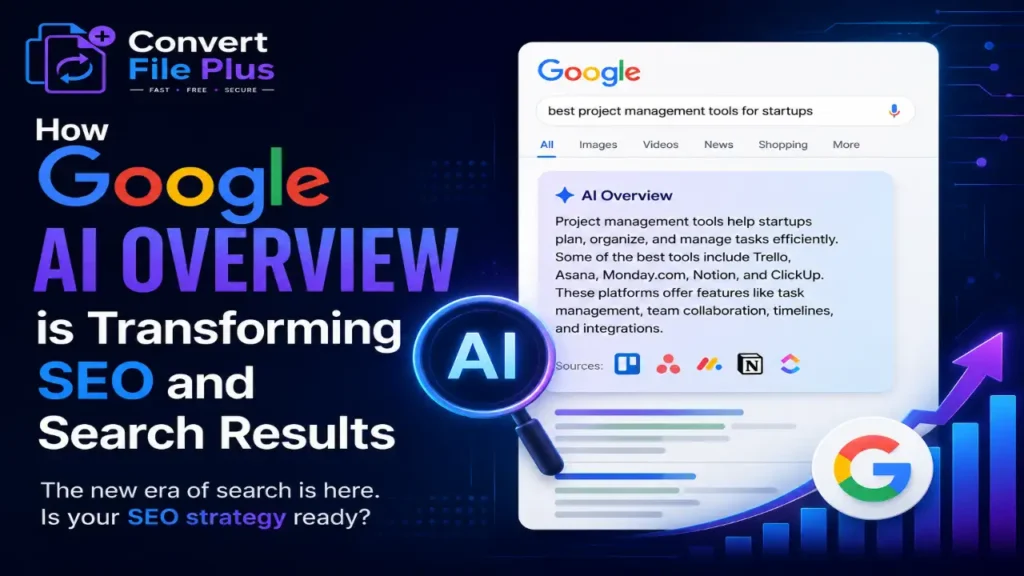
Google AI Overview is essentially a large language model-powered answer box that appears at the top of search results. When someone searches a question like “how do I reduce churn for a SaaS business,” Google doesn’t just list websites anymore it synthesizes an answer using content from across the web and presents it directly on the page.
Think of it as Google doing the reading for the user.
It pulls from multiple sources, cites them (usually), and delivers a structured summary before the user ever scrolls to the organic listings below. For certain query types how-to guides, definitions, comparison questions this can effectively remove the need to click through to a source at all.
It’s a significant change in how information flows between publishers and readers.
Why This Changes the SEO Equation
Traffic Patterns Are Already Shifting
The clearest impact is on what marketers call “informational queries” the top-of-funnel searches that brands have used for years to build awareness and drive blog traffic. These are the first to get absorbed by AI Overviews.
Early data from publishers and SEO platforms like Semrush and Ahrefs suggests that click-through rates on informational queries have declined in searches where AI Overviews appear. The exact drop varies by industry and query type, but the directional trend is consistent: when Google answers the question on-page, fewer users click through to the source.
That creates a real tension for content-heavy businesses the very articles they’ve invested in creating are now being used to train and feed an AI that reduces the need to visit their site.
Transactional Queries Are (For Now) More Protected
Here’s the nuance that often gets lost: not all search traffic is equally affected. Transactional queries “buy running shoes online,” “SaaS project management tool pricing,” “book a hotel in Jaipur” still tend to generate clicks because the user needs to take an action that Google can’t complete for them.
The same goes for highly specific, niche, or localized queries. If someone is searching for a very particular product, a local service, or a recent event, AI Overviews tend to be less complete, and users still click through.
For now, the closer a query is to a purchase decision or a specific human need, the less disruption businesses are likely to feel.
What Businesses Are Getting Wrong About This
Treating It Like a Search Algorithm Update
Most major algorithm updates Panda, Penguin, Helpful Content required adjustments to existing strategies. Publishers cleaned up thin content, fixed technical issues, and recovered over time.
AI Overview is different. It’s not a ranking change. It’s a structural shift in how Google uses content. Businesses that respond by simply “optimizing for AI Overview” chasing featured snippets, adding FAQ sections are solving the wrong problem.
The deeper question is: what is your content actually for?
If it exists purely to rank and funnel traffic to a landing page, that model is under pressure. If it exists to demonstrate genuine expertise, build trust with an audience, and support a broader relationship with readers that still has long-term value, even if the traffic numbers look different.
Ignoring Brand and Authority Signals
Google’s AI Overview doesn’t cite randomly. It tends to pull from sources that have established credibility in their domain authoritative domains, frequently cited sources, and content that aligns with E-E-A-T (Experience, Expertise, Authoritativeness, Trustworthiness) principles.
This means that brand building, thought leadership, and genuine subject matter depth are now more directly connected to search visibility than ever before. Being cited inside an AI Overview is effectively a new form of organic reach even if it doesn’t always generate a click.
What This Means for Different Types of Businesses
For publishers and content-heavy brands: The immediate impact is real. Traffic from broad informational queries is declining for many. The response isn’t to produce less content it’s to produce content that requires human judgment, experience, and specificity that AI can’t easily replicate. Firsthand research, original data, expert interviews, and case studies become more valuable, not less.
For e-commerce and product businesses: The risk is lower in the near term. Focus on product page depth, reviews, structured data, and ensuring your brand appears in queries where users are ready to buy. Build a strong enough brand that users search for you directly.
For service businesses and B2B companies: Your audience is often searching with high intent. Ensure your expertise is visible across authoritative platforms, build relationships that generate backlinks from trusted sources, and invest in content that speaks to specific pain points your buyers actually have.
For local businesses: Local search results are still largely driven by Google Business Profile, proximity, and reviews. AI Overview has limited impact on “near me” queries for now. That may change, but it’s not the immediate priority.
The Opportunity That Most People Are Missing
Here’s something that tends to get buried in the doom-and-gloom coverage: AI Overview creates an opportunity for brands that commit to genuine authority.
For years, SEO rewarded volume. The more content you produced, the more keywords you could rank for, the more traffic you could capture. That dynamic favored well-resourced teams and content mills. It wasn’t always about quality.
AI Overview changes the incentive structure. Because it synthesizes from sources it considers credible, it effectively creates a new “premium tier” of content that gets cited and that tier is defined by real expertise, not just keyword density.
For smaller businesses with deep domain knowledge, that’s actually a more level playing field. A niche expert who writes one genuinely insightful piece has a better shot at being cited in an AI Overview than a generic content farm producing dozens of shallow articles.
Practical Steps to Take Now
There’s no single playbook here the landscape is still shifting. But a few things are clear:
- Audit your content by intent. Separate informational from transactional. Understand which parts of your content strategy are most exposed to AI Overview displacement, and which are not.
- Double down on original insight. Data, case studies, expert interviews, firsthand experience these are hard for AI to replicate and more likely to be cited when AI does generate a summary.
- Invest in brand. Direct search, branded queries, and return visitors are the traffic types least affected by AI Overview. If users know your brand and seek you out, Google’s AI summaries don’t stand between you and your audience.
- Diversify beyond search. This has been good advice for a while, but it’s more urgent now. Email lists, community platforms, social channels, and partnerships are distribution channels that Google doesn’t control.
- Monitor your metrics carefully. Impressions may hold while clicks fall. Understand what’s actually changing in your business before making dramatic pivots.
Conclusion
The businesses that will struggle with Google AI Overview are the ones whose value proposition was essentially “we ranked well for this topic.” That was never a durable competitive advantage it just happened to work for a long time.
The businesses that will adapt are the ones who use search as one channel among many, create content because it genuinely serves their audience, and have built enough brand trust that users seek them out directly.
AI Overview is a signal, not a sentence. It tells you that Google is increasingly capable of commoditizing surface-level information. The response isn’t to fight that trend it’s to operate at a level of depth and specificity that AI summaries can’t fully replace.
Search is changing. The fundamentals of building a credible, useful, trusted business are not.

- Difference Between Image Resolution and Image Size: Complete Guide (2026) - July 13, 2026
- How Much Does AI Software Cost for Startups in 2026? - July 7, 2026
- How to Use AI to Write Blog Posts Faster Without Losing Your Voice - June 28, 2026