
Here’s something that should stop you for a second: most of the photos and captions you scrolled past on Instagram or TikTok this morning probably weren’t made entirely by a human. According to Adobe’s Digital Trends 2026 report, about 87% of marketers used generative AI in at least one recurring workflow in early 2026, up from just 51% two years earlier. That’s not a small shift. That’s an industry flipping over.
I’ve been watching this space for a while now, and honestly, even I didn’t expect the pace to pick up this fast. A couple of years ago, AI tools in social media were mostly novelty add-ons a caption suggestion here, a filter there. Now they’re running entire content pipelines, from ideation to scheduling to performance analysis.
This matters beyond marketing departments. It’s really a small preview of the future of AI in everyday life how we’ll write, communicate, and even present ourselves online once AI assistance becomes the default rather than the exception. If you create content for a brand, a side hustle, or just your own personal page, this shift is already touching you, whether you’ve noticed it or not.
So let’s get into what’s actually changed, what’s working, what isn’t, and where this is realistically headed.
The Scale This Is Happening At
Before getting into the tools and tactics, it helps to see the size of the audience this content actually reaches. As per TRAI’s Telecom Services Performance Indicators report for January–March 2026, India’s internet subscriber base crossed 1.09 billion, growing 6.24% in a single quarter. That is the regulator’s own official data, not a marketing estimate.
That scale matters because it means even small efficiency gains from AI tools saving a few hours per week, or producing twice the content variations compound across an enormous, fast-growing audience. A caption tweak that improves engagement by a couple of percentage points translates into a genuinely large number of additional views when the base audience is this large.
For readers less familiar with the underlying technology, Wikipedia’s overview of generative artificial intelligence is a reasonable starting point it defines generative AI as a category of models that can produce new text, images, audio, or video based on patterns learned from existing data, which is exactly the mechanism behind most of the social media tools discussed below.
Why 2026 Feels Like a Turning Point
Social platforms have always rewarded speed. But in 2026, the sheer volume of content being produced has gone up dramatically. Research from Hootsuite’s Social Trends report notes that AI-generated articles actually surpassed human-written content online for the first time in 2025 a milestone that would have sounded far-fetched just three or four years ago.
That’s not necessarily a bad thing. It just means the bar for what counts as “normal” content output has moved. A solo creator with the right tools can now produce what used to take a five-person team.
A Few Numbers Worth Sitting With
- AI-assisted social copywriting is now used by roughly half of all marketers surveyed in recent industry research.
- Adobe’s survey of over 16,000 creators found that 59% already use generative AI tools to speed up their content workflow.
- Hootsuite reports that brands posting fewer Reels than competitors are seeing measurably lower organic reach, partly because AI-driven recommendation systems favor consistent, high-frequency posting.
None of this means quality has gone out the window, though. If anything, the brands doing well are the ones using AI for the boring, repetitive parts first drafts, variations, scheduling while keeping a human hand on tone and judgment.
Where AI Is Actually Showing Up in Content Creation
It helps to break this down by what creators and marketers are actually using AI for, rather than treating it as one big blurry trend.
1. Caption and Script Writing
Most teams aren’t asking AI to write a finished post anymore. They’re asking for a rough first pass five headline options, three tone variations and then editing from there. That’s a meaningfully different workflow than full automation, and it tends to produce better results.
2. Video Editing and Repurposing
This is probably the biggest practical win. AI tools now handle auto-cutting long videos into short clips, generating captions, and even cleaning up audio. A single podcast episode can become a dozen short-form clips in an afternoon instead of a week.
3. Visual Content and Image Generation
Static visuals carousel slides, product mockups, ad creative are increasingly AI-assisted too. That’s where things get a little more complicated, because audiences are getting better at spotting synthetic imagery, and not always reacting well to it.
4. Trend Spotting and Ideation
Social listening tools powered by AI now flag emerging conversations and formats almost in real time. For a creator trying to catch a trend before it peaks, that head start can be the difference between a viral post and a missed window.
The Trust Problem Nobody’s Fully Solved
Here’s where I’ll push back a little on the hype. More content isn’t automatically better content, and audiences are noticing the difference, even if they can’t always name it.
Multiple industry surveys have found that a meaningful share of consumers often cited in the 30–50% range depending on the study reduce engagement once they suspect a post was generated rather than written by a real person. Authenticity still matters, maybe more than ever, precisely because synthetic content has become so common.
Most people don’t think about this consciously, but they feel it. A caption that sounds slightly too polished, slightly too generic, tends to get scrolled past faster than one with a bit of personality or imperfection.
That’s probably why some of the best-performing brand accounts right now are deliberately leaning less polished more behind-the-scenes, more employee-voiced, less obviously “produced.” It’s an interesting contradiction: AI made high-production content cheap and easy, which means raw, human-feeling content became the differentiator again.
What This Says About the Future of AI in Everyday Life
Social media content creation is really just the most visible test case for something much bigger. The same patterns AI handling the repetitive groundwork while humans focus on judgment, taste, and connection are showing up in writing, customer service, design, and even healthcare documentation.
That’s the honest shape of the future of AI in everyday life: not robots replacing people outright, but a steady redistribution of where human attention goes. The tedious 80% gets automated. The remaining 20% the part that actually requires judgment becomes more valuable, not less.
For content creators specifically, that means the people who’ll do well aren’t the ones avoiding AI tools, and they’re not the ones blindly publishing whatever AI spits out either. They’re the ones who treat AI as a fast first draft and themselves as the editor with the final say.
Practical Takeaways for Creators and Brands
If you’re trying to figure out where to actually focus your energy, here’s what seems to separate the accounts that are growing from the ones that are stalling:
- Use AI for speed, not for voice. Let it draft outlines or caption variations, but rewrite the final version in your own words.
- Be upfront when it’s relevant. Audiences generally don’t mind AI assistance they mind feeling misled about it.
- Don’t sacrifice frequency for perfection. Algorithms still reward consistency, and AI tools make consistency far easier to maintain.
- Keep a real person in the loop. Even a quick human edit pass noticeably improves how content lands.
- Watch the trust signals. If engagement quietly drops after a run of heavily produced posts, that’s worth investigating before it becomes a pattern.
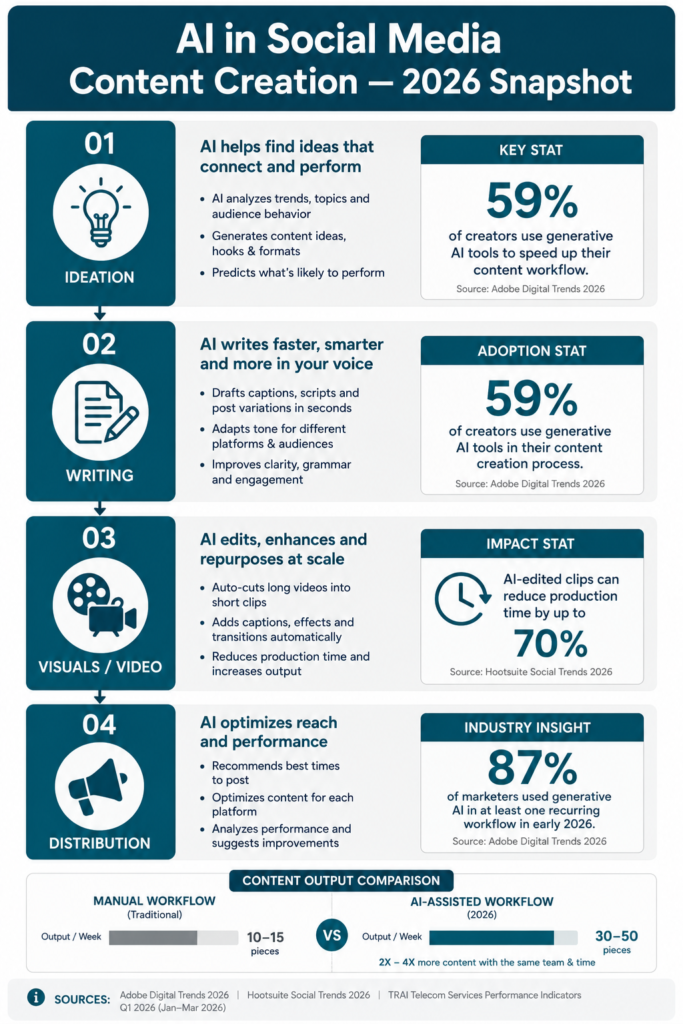
Suggested Alt Text: “Infographic showing four stages of AI-assisted social media content creation in 2026 ideation, writing, visuals and video, and distribution with adoption statistics for each stage.”
A Few Honest Caveats
It’s worth saying plainly: not every AI content tool delivers what it promises, and platforms are still figuring out how to label or moderate synthetic media consistently. Deepfake-style impersonation and low-quality “AI slop” content are real, ongoing problems, not solved ones.
That’s understandable, given how fast the tools have moved compared to the policies meant to govern them. If you’re building a content strategy around AI, it’s worth checking platform-specific guidelines periodically, since labeling rules and disclosure requirements are still evolving.
Conclusion
So, where does this leave creators, brands, and honestly anyone scrolling their feed in 2026? AI hasn’t replaced the creative process. It’s compressed it turning what used to take hours into minutes, and shifting the real work toward editing, judgment, and knowing what’s actually worth publishing.
That’s a useful way to think about the future of AI in everyday life more broadly. The tools keep getting faster and more capable, but the meaningful differentiator stays remarkably human: taste, honesty, and the willingness to sound like an actual person rather than a polished output.
If there’s one thing I’d want a reader to walk away with, it’s this: the question isn’t whether to use AI in content creation anymore that decision has basically been made for most of the industry. The real question is how much of yourself you’re still willing to put into the work once the tool can do the rest. That’s worth sitting with, longer than a scroll.
Frequently Asked Questions

- Difference Between Image Resolution and Image Size: Complete Guide (2026) - July 13, 2026
- How Much Does AI Software Cost for Startups in 2026? - July 7, 2026
- How to Use AI to Write Blog Posts Faster Without Losing Your Voice - June 28, 2026