
Most technology conversations eventually circle back to software. Apps, platforms, models, APIs — that’s where the investment dollars go and where most of the headlines live. But quietly, a different kind of shift is underway. The physical world is catching up.
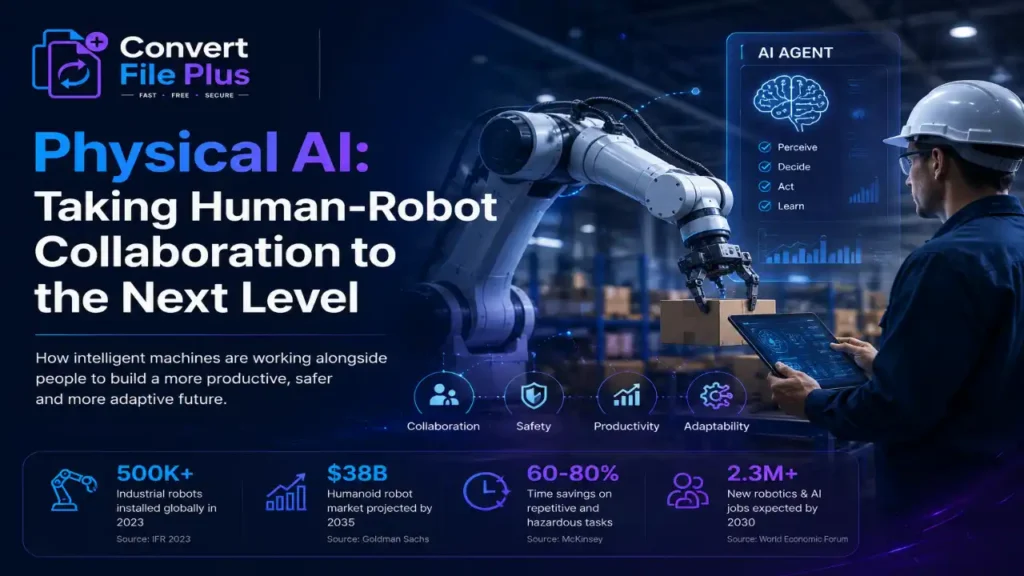
Physical AI the integration of artificial intelligence into robots, machines, and embodied systems that interact with the real world has moved from a niche research topic into a genuine business priority. According to the International Federation of Robotics, global installations of industrial robots crossed 500,000 units in a single year for the first time in 2023. Meanwhile, venture investment in robotics and physical AI startups reached multi-year highs through 2024, with analysts at Goldman Sachs projecting the humanoid robot market alone could hit $38 billion by 2035.
These numbers matter less as statistics and more as a signal. Capital follows conviction, and right now, a lot of smart money believes that AI embedded in physical systems is the next major productivity frontier.
For business owners and operators, the question isn’t whether Physical AI will affect your industry. It almost certainly will. The more useful question is: what does it actually mean in practice, and what should you be doing before 2030 to stay ahead of it?
Read Also : Top 10 Best Autonomous AI in 2026 (That Can Work Without Human Input)
What Exactly Is Physical AI?
Strip away the jargon and Physical AI is fairly straightforward: it’s artificial intelligence that doesn’t just think — it acts in the real world.
A regular AI model reads text and generates a response. A Physical AI system perceives its environment through sensors, makes decisions, and then moves, grabs, assembles, inspects, or navigates — depending on what it was built to do.
Think of a warehouse robot that doesn’t just follow a preset path but actually “sees” a misplaced box, recalculates its route, and adjusts its grip based on the object’s weight distribution. Or a surgical assistant that tracks a surgeon’s movements in real time and hands over the right instrument before it’s asked for.
The intelligence is embedded in the body of the machine, not just running in a cloud somewhere.
Why Human-Robot Collaboration Is Changing
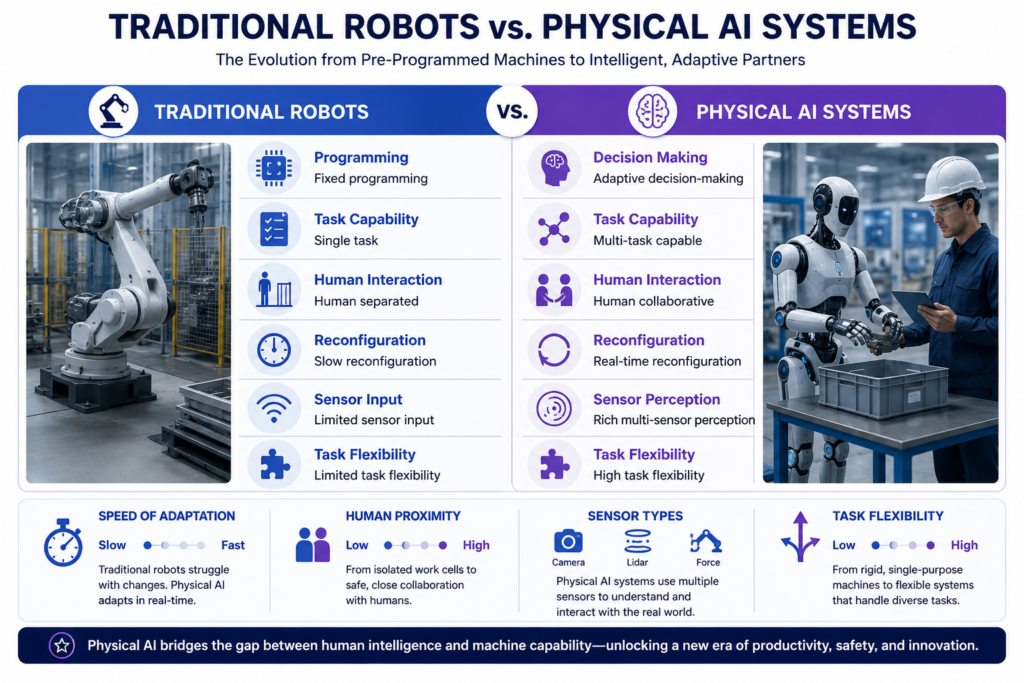
For decades, industrial robots and humans operated in separate spaces — literally. Robots were caged off on factory floors for safety reasons. The work was divided: machines handled repetitive, high-volume tasks; humans handled everything that required judgment, dexterity, or adaptability.
That boundary is dissolving.
The newer generation of collaborative robots — often called “cobots” — are designed to work alongside people without physical barriers. And with Physical AI layered in, these systems are developing the kind of contextual awareness that makes true collaboration possible.
Here’s what’s actually shifting:
- From pre-programmed to adaptive. Older industrial robots needed precise, repeatable conditions. Physical AI systems can handle variation — different objects, unexpected obstacles, changing environments.
- From task execution to task assistance. Rather than replacing a human’s job wholesale, many Physical AI systems are being designed to handle the parts of a job that are physically demanding, hazardous, or tedious — leaving humans to focus on the decision-making layer.
- From isolated to integrated. Modern Physical AI systems communicate with other systems, feed data back into operations software, and respond to human instructions in natural language. The interface is becoming conversational, not just mechanical.
- From industrial-only to cross-sector. Logistics, healthcare, agriculture, construction, retail fulfillment — Physical AI is expanding well beyond the factory floor.
The Real Business Problems Physical AI Can Solve
This is where it gets practical. Physical AI isn’t an abstract capability — it maps directly onto recurring operational pain points across industries.
Warehouse and Fulfillment Operations
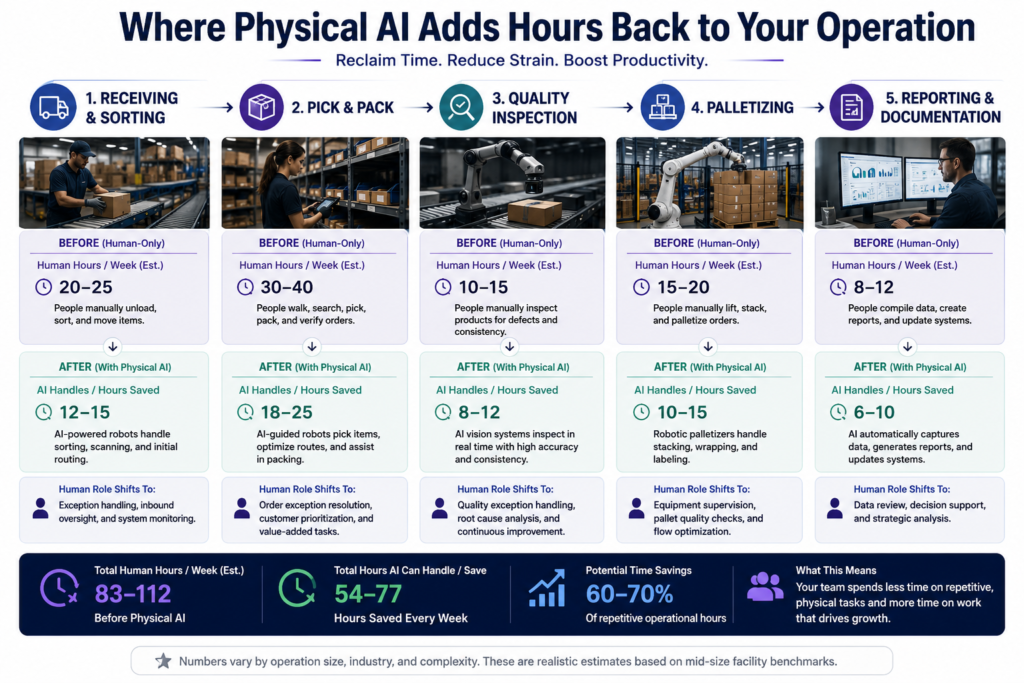
Pick-and-place tasks, inventory sorting, and order fulfillment are among the most labor-intensive and error-prone functions in logistics. Physical AI systems can now handle variable product shapes and sizes — the long-standing challenge that kept robotics from working well in mixed-SKU environments. Amazon, Ocado, and a growing list of third-party logistics providers are already running hybrid human-robot floors where throughput is measurably higher.
Construction and Infrastructure
Labor shortages in construction are severe and structural. Physical AI is being applied to tasks like bricklaying, rebar tying, and concrete inspection — work that is physically punishing and skill-dependent. Startups like Scaled Robotics and Dusty Robotics are deploying systems that handle the groundwork while human tradespeople manage installation, quality decisions, and coordination.
Healthcare and Patient Support
Hospitals face a compounding problem: aging populations, nursing shortages, and the physical demands of patient care that lead to high injury and burnout rates. Robotic assistants designed for patient lifting, medication delivery, and room preparation are taking on physical tasks that don’t require clinical judgment — freeing clinical staff for work only they can do.
Agriculture
Harvesting, weeding, and crop monitoring are labor-intensive and weather-dependent. Physical AI systems equipped with computer vision can identify ripe produce, navigate field terrain, and work across extended hours without fatigue. This matters especially in regions where seasonal labor is unreliable or expensive.
Quality Control and Inspection
Manufacturing and engineering environments require consistent, detailed inspection — often in conditions that are poor for human performance (heat, noise, confined spaces). AI-powered inspection systems can detect defects at micron levels, flag anomalies in real time, and generate audit trails automatically.
Why Smaller Operations May Benefit Disproportionately
Large enterprises have resources to absorb inefficiency. They have redundant staff, buffer inventory, and financial cushion. Smaller operations don’t — which means the gains from Physical AI are often proportionally larger for businesses running lean.
A mid-size food packaging company running three shifts with 40 people on the floor has limited ability to absorb an injury-related absence or a spike in order volume. A Physical AI system that handles palletizing doesn’t just improve throughput — it removes a fragility point.
Cost trajectories are also moving in the right direction. Robot hardware costs have fallen significantly over the past decade, and the software layer — the AI that makes them genuinely useful — is increasingly available through cloud platforms and robotics-as-a-service models. You no longer need to own the entire capital stack to access capable systems.
For founders and operators running growth-stage businesses, the calculation is changing. Physical AI is becoming something you can pilot with a defined budget and a specific use case — not just a strategic initiative that requires a full transformation program.
The Economics Are Hard to Ignore
Let’s look at some numbers, without the hype.
McKinsey estimates that automation technologies — including Physical AI — could raise global productivity growth by 0.8 to 1.4 percentage points annually. The World Economic Forum projects that while automation will displace certain roles, it will also create new categories of work — technician, trainer, overseer, integration specialist — that didn’t exist before.
On the business level, the economics tend to work through three channels:
Labor cost reduction on specific tasks. Not eliminating headcount, but redeploying it. Physical AI handles the repetitive and hazardous portions; humans focus on judgment-intensive work. Unit economics improve.
Error reduction and quality consistency. In manufacturing and fulfillment, even small defect rates translate to significant rework and return costs. AI-driven inspection and handling reduces variation.
Extended operational hours. Physical AI systems work across shifts without overtime costs, scheduling constraints, or fatigue-related error rates. For operations with time-sensitive delivery windows, this is material.
The competitive pressure is worth noting. In any industry where a competitor deploys Physical AI effectively and achieves a meaningful cost or quality advantage, the pressure on others to follow becomes significant — and fast.
Challenges Worth Taking Seriously
Physical AI is not without complications. Any honest assessment has to include them.
Integration complexity. Real-world environments are messy. Deploying a Physical AI system in an existing facility — with existing workflows, older equipment, and people accustomed to doing things a certain way — is harder than it looks in a demo. Implementation timelines and costs frequently exceed initial estimates.
Safety and liability. When a physical system fails — and sometimes they do — the consequences can be more serious than a software crash. Who is liable when a robot makes an error that injures a worker or damages inventory? Insurance, regulatory, and legal frameworks are still catching up.
Workforce dynamics. The conversation about robots “taking jobs” is often oversimplified, but it’s not without basis. Organizations that deploy Physical AI without thinking carefully about how to communicate with and support affected employees will create internal friction that undermines the benefit.
Data and security. Physical AI systems are data-intensive. They collect sensor data, operational data, and environmental data continuously. That data needs to be secured, and the systems themselves need to be resilient to tampering or interference — particularly in critical infrastructure contexts.
Skills gaps. Operating and maintaining Physical AI systems requires a different skill set than traditional equipment. Building that capability — whether through hiring, training, or partnerships — takes time and investment.
What Businesses Should Do Today to Prepare for 2030
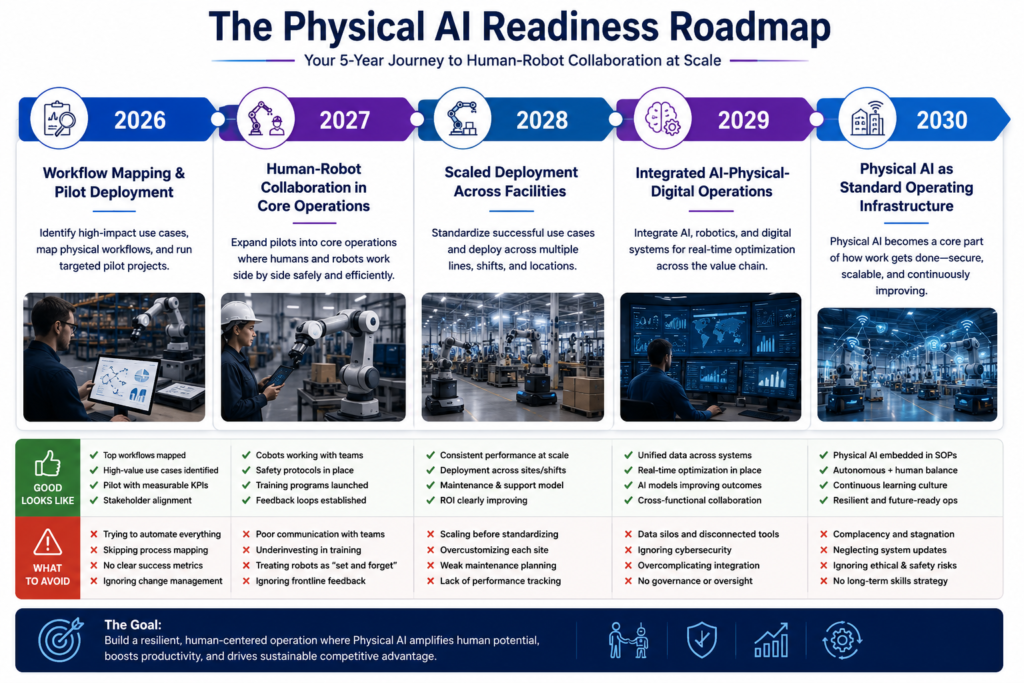
The businesses that will be best positioned in five years aren’t necessarily the ones spending the most on robotics today. They’re the ones building organizational readiness — the processes, the people, and the decision-making clarity to deploy well when the time is right.
Some practical starting points:
- Map your physical workflows. Before thinking about technology, document the physical tasks in your operation: which are most repetitive, which carry the highest injury risk, which are the hardest to staff reliably. That’s your candidate list for Physical AI.
- Run a contained pilot. Pick one problem. Deploy a system with clear success metrics. Learn from it before scaling. The organizations that struggle with Physical AI adoption tend to try to do too much at once.
- Invest in AI and robotics literacy for your team. Not everyone needs to be a robotics engineer. But managers, operations leads, and floor supervisors who understand what these systems can and can’t do will make better decisions and smoother deployments.
- Build vendor relationships now. The Physical AI vendor landscape is maturing but still fragmented. Identifying the suppliers, integrators, and platform providers that fit your industry now gives you an advantage when you’re ready to move.
- Think about your workforce proactively. Decide early how Physical AI fits into your employment philosophy — not as an afterthought. Organizations that bring employees into the conversation tend to get better outcomes.
- Keep humans in oversight roles. Physical AI systems still make mistakes. Design your processes so that human judgment is available at critical decision points, and build feedback loops that let you improve system performance over time.
A Closing Thought
Physical AI isn’t going to change everything overnight. Real operational transformation moves slowly, and the hype around robotics and embodied AI has a long history of outpacing reality in the short term.
But the underlying trend is genuine. The systems are getting more capable, the costs are coming down, and the range of practical applications is expanding faster than most people expected. For founders and operators who prefer to build rather than react, the window for thoughtful preparation is open now.
Human-robot collaboration, done well, isn’t about replacing people with machines. It’s about being clear-eyed about what machines are better at — consistency, endurance, precision under conditions humans find difficult — and what people are better at: judgment, relationships, adaptability in genuinely novel situations.
The businesses that figure out that combination early, and build operations around it deliberately, will carry a durable advantage into the next decade. The ones that wait for the technology to become unavoidable will be managing catch-up rather than building capability.
That distinction is worth thinking about today.

- Difference Between Image Resolution and Image Size: Complete Guide (2026) - July 13, 2026
- How Much Does AI Software Cost for Startups in 2026? - July 7, 2026
- How to Use AI to Write Blog Posts Faster Without Losing Your Voice - June 28, 2026