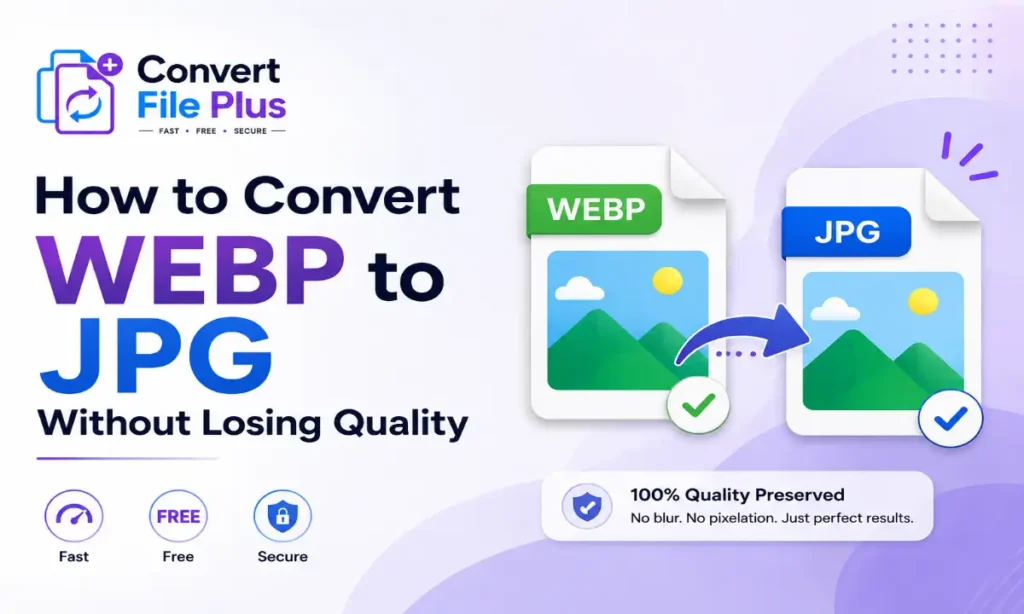
If you’ve ever downloaded an image from a website and ended up with a .webp file, you’re not alone. WEBP is Google’s modern image format — smaller, faster, but not always supported everywhere. Converting WEBP to JPG sounds simple, but doing it without losing quality requires the right approach. This guide covers exactly what you need to know: why quality loss happens, which methods work best, and how to get a clean, high-quality JPG every single time.
What Is a WEBP File?
- Developed by Google in 2010 as a replacement for older image formats
- Purpose: To make web images load faster by reducing file sizes without visible quality loss
- Supports both lossy and lossless compression, giving developers flexibility
- Supports transparency (alpha channel), similar to PNG
- Browser compatible with Chrome, Firefox, Edge, and Safari (Safari added support in 2020)
- Common use cases: Website images, product photos in e-commerce, web app assets, social media previews
Quick Facts About WEBP
- Launch year: 2010 (by Google)
- Transparency support: Yes — full alpha channel
- Compression types: Both lossy and lossless
- File size reduction: On average, 25–34% smaller than JPG at equivalent quality (according to Google’s own benchmarks)
- Browser adoption: Supported by over 96% of browsers worldwide as of 2024 (Can I Use data)
- Animation support: Yes — WEBP can replace animated GIFs too
Why Convert WEBP to JPG?
Despite WEBP’s advantages, there are many situations where JPG is the more practical choice:
- Universal compatibility — JPG works in every software, operating system, browser, and device without exception
- Social media uploads — Several platforms, especially older apps, do not accept WEBP files
- Printing requirements — Most print shops and design tools require JPG or PNG, not WEBP
- Software limitations — Legacy tools like older Photoshop versions, Microsoft Office 2016 and below, and some CMS platforms do not support WEBP
- Easier sharing via email — Many email clients display JPG images inline; WEBP may show as an attachment or broken image
- Client deliverables — Clients and vendors often expect standard formats like JPG for photos and product images
Practical example: You download a product image from a supplier’s website. It arrives as a WEBP file. Your e-commerce platform only accepts JPG. That’s exactly when WEBP to JPG conversion becomes necessary.
Does Converting WEBP to JPG Reduce Image Quality?
The short answer: it can, but it doesn’t have to.
Here’s why:
- Lossy WEBP → JPG: If the original WEBP used lossy compression, some data was already discarded. Converting to JPG applies a second round of compression. This can cause visible quality loss if settings aren’t right.
- Lossless WEBP → JPG: If the WEBP was losslessly compressed, converting to JPG with high quality settings will produce a near-identical result.
- What actually causes quality loss:
- Saving at low quality settings (below 80%)
- Converting the same file multiple times
- Resizing during the conversion process
- Using unreliable or low-quality converter tools
The key is: convert once, from the original file, at maximum quality settings.
Main Reasons Quality Drops During Conversion
- Multiple conversions — Every time you save a lossy image, more data is thrown away. WEBP → JPG → JPG again is a quality disaster.
- Low export quality settings — Most tools default to 70–80% quality. For professional use, always set it to 90–100%.
- Excessive compression — Some online converters automatically compress output to reduce file size. Disable this option if available.
- Resizing during conversion — Scaling down an image while converting adds another layer of data loss.
- Metadata removal — While not a visual quality issue, stripping EXIF data (camera settings, location) affects the file’s usefulness in professional workflows.
How to Convert WEBP to JPG Without Losing Quality
Step 1: Use a Reliable Converter
- Look for converters that let you manually set output quality (not just “high/medium/low”)
- Check for batch conversion support if you have multiple files
- Prioritize tools with no file size limits for large images
- For sensitive images, choose desktop software over online tools to avoid uploading private files
- Verify the tool does not auto-compress the output
Step 2: Select Maximum Quality Settings
- Set output quality to 90–100% for professional results
- Avoid “auto” quality settings — they often optimize for file size, not quality
- If the tool offers a quality slider, always drag it to the highest end
- For print-ready files, aim for 300 DPI resolution in addition to high quality
Step 3: Keep Original Resolution
- Never upscale an image during conversion — it adds pixels artificially and blurs the result
- Do not resize unless absolutely required
- If resizing is needed, do it after conversion as a separate step
- Keep the aspect ratio locked to prevent distortion
Step 4: Avoid Repeated Conversions
- Always convert from the original WEBP file
- Do not re-convert an already-converted JPG
- Store your original WEBP files in a backup folder before converting
- Label converted files clearly (e.g.,
image-converted.jpg) so you don’t accidentally reconvert
Step 5: Verify Image Quality Before Downloading
- Zoom into the image at 100% view to check for pixelation, banding, or blur
- Compare it side by side with the original WEBP if the tool allows preview
- Check edges, text within images, and shadow areas — these degrade first
- Confirm the output file size is reasonable — if it’s much smaller than the original, quality may have been compressed
Best Methods to Convert WEBP to JPG
Method 1: Online WEBP to JPG Converter
Advantages:
- No software installation required
- Works on any device, including mobile
- Fast for individual files
- Many are free
Limitations:
- May have file size limits (typically 5–20MB per file)
- Privacy concerns — files are uploaded to external servers
- Quality control varies between tools
- Internet connection required
Best use cases: Quick one-off conversions of non-sensitive images
Recommended approach: Search for an online WEBP converter, upload your file, set quality to maximum (if the option exists), download the result.
Method 2: Adobe Photoshop
Steps:
- Open the WEBP file in Photoshop (File → Open)
- Go to File → Export → Export As
- Select JPG from the format dropdown
- Set quality to 10 (Maximum) on Photoshop’s 1–10 scale
- Keep the resolution unchanged
- Click Export and save
Benefits:
- Full control over quality, resolution, and color profile
- Supports batch processing via Actions
- Industry-standard output quality
Professional use cases: Commercial photography, print production, marketing assets
Method 3: Windows Built-In Tools
Steps:
- Right-click the WEBP file → Open with → Paint
- Go to File → Save As
- Select JPEG Picture from the dropdown
- Click Save
Alternative via Photos app:
- Open the WEBP in the Photos app
- Click the three-dot menu → Save As
- Choose JPG format and save
Benefits:
- No downloads or installs needed
- Works on any Windows 10/11 PC
- Completely free
Method 4: Mac Preview
Steps:
- Open the WEBP file in Preview (default image viewer on Mac)
- Go to File → Export
- Choose JPEG from the Format dropdown
- Set the Quality slider to maximum (drag fully right)
- Click Save
Benefits:
- Built into every Mac — no cost, no install
- Quality slider gives you control
- Handles batch conversion via selecting multiple files
Method 5: Bulk Conversion Software
Advantages:
- Convert hundreds of WEBP files to JPG in one click
- Consistent quality settings across all files
- Often includes resizing, renaming, and metadata tools
- Saves significant time for large projects
Suitable users:
- Web developers migrating image libraries
- E-commerce managers converting product photo batches
- Photographers delivering client galleries
- Content teams managing large media archives
Popular tools: XnConvert (free), IrfanView (free), ImageMagick (free, command-line)
WEBP vs JPG Comparison
| Feature | WEBP | JPG |
|---|---|---|
| File Size | 25–34% smaller on average | Larger, but widely optimized |
| Image Quality | Excellent (lossy & lossless) | Very good (lossy only) |
| Compatibility | 96%+ browsers; limited in software | Universal — works everywhere |
| Transparency | Supported (alpha channel) | Not supported |
| Compression | Lossy + Lossless | Lossy only |
| Website Performance | Better (smaller files = faster load) | Good, slightly slower |
| Printing Support | Limited | Fully supported |
Summary:
- WEBP is better for web performance and modern browsers
- JPG is better for universal sharing, printing, and software compatibility
- For websites: use WEBP where possible
- For offline use, printing, or sharing: convert to JPG
Tips to Preserve Image Quality During Conversion
- Always use the original file — never convert a copy of a copy
- Avoid multiple saves — each lossy save reduces quality
- Choose 90–100% output quality — never accept default “medium” settings
- Preserve original dimensions — do not resize during conversion
- Compare before and after — zoom to 100% and check fine details
- Keep backups — store the original WEBP before converting
- Disable auto-compression — if the tool offers this option, turn it off
- Match color profiles — ensure sRGB is selected for web/screen use and Adobe RGB for print
Common Mistakes to Avoid
- Choosing the lowest quality setting — to save file size. Use high quality and compress later if needed.
- Upscaling images — converting a 500×500 WEBP to a 1000×1000 JPG does not add real detail; it just blurs it.
- Converting screenshots incorrectly — screenshots often have text and sharp edges. Use PNG instead of JPG for screenshots to avoid compression artifacts.
- Ignoring output resolution — for print, 72 DPI (screen resolution) is not enough. You need 300 DPI.
- Using unreliable converters — some add watermarks, strip metadata without warning, or silently reduce quality.
- Deleting originals too early — always keep the WEBP source until you’ve confirmed the JPG output looks perfect.
When Should You Use JPG Instead of WEBP?
- Printing — Print labs, photo printers, and design agencies universally accept JPG. WEBP is rarely supported.
- Client file sharing — Non-technical clients may not know how to open WEBP files. JPG is always safe.
- Legacy software — Older versions of Word, PowerPoint, and design tools don’t support WEBP.
- Email attachments — Many email clients do not render WEBP inline. JPG displays correctly everywhere.
- Presentation documents — Adding images to PowerPoint, Keynote, or Google Slides works reliably with JPG.
- Portfolio submissions — Job boards, stock photo platforms, and submission portals typically require JPG or PNG.
Statistics and Industry Insights
- WEBP is currently used on over 10 million websites worldwide (W3Techs, 2024)
- Google reports WEBP files are on average 25–34% smaller than JPG at comparable quality
- Browser support for WEBP has reached 96.4% globally (Can I Use, 2024)
- A 1-second delay in page load time caused by large images can reduce conversions by 7% (Akamai research)
- Image optimization is among the top 3 recommendations in Google PageSpeed Insights for most websites
- According to HTTP Archive, images account for approximately 50% of a typical webpage’s total size, making format choice a critical performance decision
- The image optimization market is growing, driven by the rise in mobile-first browsing where file size directly impacts load speed on cellular networks
Frequently Asked Questions
Is WEBP better than JPG? For websites, yes — WEBP is smaller and loads faster. For printing, universal sharing, or legacy software, JPG is the better choice. Both have their place.
Can I convert WEBP to JPG for free? Yes. Tools like Mac Preview, Windows Paint, IrfanView, and many online converters are completely free.
Will transparency be preserved when converting to JPG? No. JPG does not support transparency. Transparent areas in a WEBP will be filled with a solid background color (usually white) during conversion. If you need to keep transparency, convert to PNG instead.
Does converting WEBP to JPG affect image resolution? Only if you allow the converter to resize the image. Always confirm the output resolution matches the original before saving.
Which converter maintains the best quality? Adobe Photoshop gives the most control for professional work. For free options, Mac Preview and IrfanView produce excellent results when quality is set to maximum.
Can I convert multiple WEBP files to JPG at once? Yes. Tools like XnConvert, IrfanView, and ImageMagick support batch conversion. Adobe Photoshop also supports batch processing through Actions.
Is WEBP supported by all browsers? Almost. WEBP is supported by over 96% of browsers worldwide. The only notable exception is Internet Explorer, which is no longer in mainstream use.
What quality setting should I choose? Set quality to 90–100% for any professional, print, or archival use. 80–90% is acceptable for web images where file size matters.
Can I revert from JPG back to WEBP? Yes, but the image will not regain any quality that was lost during the JPG conversion. Always keep the original WEBP if you plan to go back.
Does converting WEBP to JPG change the file size? Usually yes. JPG files are typically larger than their WEBP equivalents. The exact size depends on the quality setting and image content.
Conclusion
Converting WEBP to JPG is straightforward, but doing it without losing quality requires a bit of care. Quality loss happens when you use low export settings, convert the same file multiple times, or rely on tools that auto-compress your output without telling you.
The key takeaways:
- Always convert from the original WEBP file
- Set output quality to 90–100%
- Do not resize during conversion
- Keep the original file as a backup
- Use trusted tools — desktop software like Photoshop or Preview gives the most control
Whether you’re converting one image or a thousand, following these steps will ensure your JPG files look as close to the original as possible. The format may change, but the quality doesn’t have to.

- Difference Between Image Resolution and Image Size: Complete Guide (2026) - July 13, 2026
- How Much Does AI Software Cost for Startups in 2026? - July 7, 2026
- How to Use AI to Write Blog Posts Faster Without Losing Your Voice - June 28, 2026