
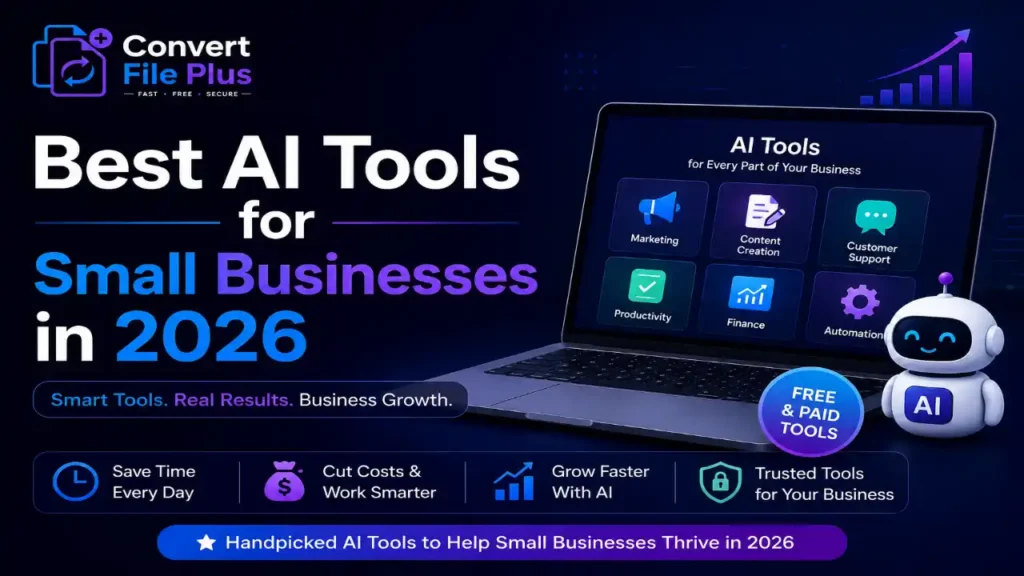
A few weeks ago, a friend who runs a six-person marketing agency told me she’d stopped hiring freelance copywriters altogether. Not because business slowed down – quite the opposite. She’d simply found enough AI tools for small business owners to cover the gap herself, in less time, for less money.
That conversation stuck with me, because it’s not an isolated story anymore. According to the U.S. Chamber of Commerce’s 2025 Empowering Small Business Report, 58% of small businesses now say they use generative AI, up from just 40% the year before. That’s a fast jump for any technology, let alone one that barely existed in its current form three years ago.
And it’s not just hype. McKinsey’s Global Survey on AI found that 88% of organizations now report regular AI use in at least one business function. Small companies are catching up to that number quicker than most people expected – partly because the best ai tools for small business owners can use today don’t require a developer, a budget approval process, or even much technical patience.
So if you’re a small business owner wondering where to actually start, or whether the tool you picked last year is still worth paying for, this guide walks through what’s genuinely useful right now – split between free and paid options, and organized by what you’re actually trying to get done.
Why AI Tools for Small Business Owners Matter More in 2026
Most small businesses don’t have a marketing department, a customer support team, or an ops manager. They have one or two people doing all three jobs before lunch. That’s exactly the gap AI tools are filling.
It’s worth saying plainly: you don’t need ten tools. You need two or three that solve real, recurring problems – writing, scheduling, customer replies, or basic bookkeeping. Everything else is a distraction dressed up as productivity.
- Time savings on repetitive writing and admin tasks
- Lower costs compared to hiring contractors or new staff
- Faster customer response times, even outside business hours
- Better-informed decisions from data you already have but never had time to look at
AI for Small Business Marketing: Where Most Owners Start
Marketing is usually the first place small businesses bring in AI, and that’s not a coincidence. Content takes time, and most owners aren’t trained copywriters or designers.
Free Tools
- ChatGPT (Free tier) – good for drafting social captions, email copy, and basic blog outlines.
- Canva’s free AI features – quick graphics, background removal, and text-to-image for social posts.
- Google’s Gemini (free tier) – handy for research and quick rewrites inside Gmail and Docs.
Paid Tools
- Claude (Pro plan) – strong for longer-form writing, brand voice consistency, and handling multiple documents at once.
- HubSpot Marketing Hub – combines AI content generation with email automation and basic CRM, useful once you outgrow spreadsheets.
- Jasper – built specifically for marketing teams that need consistent tone across many pieces of content.
Honestly, most solo owners don’t need all of these. Pick one writing tool and one design tool, and use them properly for three months before adding anything else.0
[INFOGRAPHIC NEEDED HERE]
AI Assistant for Small Business Owners: Handling the Daily Grind
This is where AI quietly saves the most time – not in flashy marketing campaigns, but in the boring stuff. Scheduling. Replying to the same five customer questions. Sorting invoices.
- Motion or Reclaim.ai – auto-schedule your calendar around priorities instead of manually shuffling meetings.
- Notion AI – summarizes meeting notes and turns messy docs into action items.
- Intercom Fin or Tidio – AI chat assistants that answer common customer questions without you lifting a finger.
- QuickBooks AI features – flags unusual expenses and helps with basic cash flow forecasting.
That gap between buying a tool and actually using it well is bigger than most people admit. Salesforce’s SMB Trends research found that small businesses using AI consistently report stronger revenue growth than non-adopters – but the businesses seeing the clearest results tend to be the ones using tools daily, not occasionally.
AI Tools for Small Businesses and Startups: Operations and Growth
Startups have slightly different needs than an established local business. There’s usually more pressure to move fast and prove traction quickly, often with a fraction of the budget a bigger company would have.
Free or Low-Cost
- Zapier’s free tier – connects apps so tasks happen automatically without writing code
- Perplexity (free) – fast, source-backed research for market analysis or competitor checks
- Looker Studio with AI-assisted insights – free dashboards pulling from Google Sheets or Analytics
Worth Paying For
- Zapier Pro or Make.com – for more complex automation across five or more tools
- Gong or Fireflies.ai – meeting transcription and sales call analysis
- Airtable with AI fields – lightweight database management with built-in summarization
One thing I’d flag here: startups sometimes over-automate before they’ve nailed down the process they’re automating. It’s worth running a workflow manually a few times first, just to be sure it’s worth automating at all.
Choosing the Right AI Tools for Small Business Budgets
There’s no universal answer here, and honestly, anyone who tells you there is one tool that fits every small business probably hasn’t run one.
A few questions worth asking before you subscribe to anything:
- What task am I doing manually, every single week, that I genuinely dislike?
- Would saving two or three hours a week actually change anything for the business?
- Can I trial this for free before committing to an annual plan?
- Does this tool handle customer data responsibly? Read the privacy policy, not just the marketing page.
That last point matters more than people think. Plenty of consumer-grade AI tools weren’t built with business data handling in mind, and small businesses are often the ones with the least time to clean up a mess if something goes wrong.
The Real Cost of Doing Nothing
It’s tempting to wait and see how this all settles. But McKinsey’s 2025 Global Survey on AI also found that organizations actively redesigning workflows around AI – not just bolting it on – are the ones seeing measurable bottom-line impact. The tools matter less than how consistently they’re used.
That’s really the practical takeaway for small business owners heading into the rest of 2026. The tools for small business marketing, scheduling, and operations are now affordable and genuinely capable. The bottleneck isn’t access anymore. It’s deciding what to actually hand off, and sticking with it long enough to see the difference.
Final Thoughts
None of this means AI replaces good judgment, decent customer relationships, or a product people actually want. It just clears space for the parts of running a business that still need a human paying attention.
If you’re picking your first ai tools for small business use this year, start small. One tool for writing, one for scheduling or support, used properly for a season before you add a third. That’s usually enough to feel the difference in your week.
I’ve noticed the owners who get the most out of AI aren’t the ones chasing every new release. They’re the ones who picked something boring and reliable, and just kept using it. That’s not a flashy conclusion, but it’s probably the honest one.

- Difference Between Image Resolution and Image Size: Complete Guide (2026) - July 13, 2026
- How Much Does AI Software Cost for Startups in 2026? - July 7, 2026
- How to Use AI to Write Blog Posts Faster Without Losing Your Voice - June 28, 2026