Here’s something I’ve noticed after years of writing about gear: most people buy their first “real” camera within six months of deciding they’re serious about photography – and then quietly return it within a year. Not because the camera was bad. Because nobody told them which spec actually mattered for what they wanted to shoot.
That’s the real story behind almost every “best camera” search. People aren’t actually confused about specs sheets. They’re confused about priorities. And honestly, that’s fair – sensor sizes, autofocus systems, lens mounts, it’s a lot to take in when all you wanted was something that beats your phone.
If you’re hunting for the best beginner cameras in 2026, here’s the good news: it’s genuinely a strong year to buy. Entry-level mirrorless bodies now ship with autofocus tracking that, five years ago, only showed up on professional cameras costing three times as much. Canon, Nikon, Sony, Fujifilm, OM System, and Panasonic all make solid beginner cameras – and brand loyalty at this stage is honestly a bit premature.
So let’s skip the brand-war nonsense and get into what actually matters when picking among the best cameras for beginners, plus which models are worth your money right now.
Read Also : Best AI Photo Editing Tools in 2026: Lightroom AI vs Luminar AI vs Photoshop AI
What Actually Makes a Camera “Beginner-Friendly”
A lot of guides treat “beginner-friendly” as a fancy way of saying “cheap.” That’s only half the story.
The real markers of a good beginner camera, in my experience, look more like this:
- Reliable, fast autofocus – so you’re not wrestling the camera to get a sharp shot of your kid or dog
- A clear, guided menu system – not a maze of settings borrowed from a professional body
- A lens ecosystem you won’t outgrow in a year – this matters more than most people expect
- A manual mode that’s actually approachable, so you learn instead of just pointing and shooting forever
- A reasonable upgrade path, because two years from now you might want more
There’s no single universal beginner camera – what matters depends entirely on what you actually point it at most. Someone shooting their toddler’s soccer games needs different things than someone documenting weekend hikes or building a YouTube channel.
That’s worth sitting with for a second, because it changes how you should shop. Instead of asking “what’s the best camera,” try asking “what am I actually going to use this for, most weekends?”
Best Cameras for Photography Beginners: The Top Picks
Here’s where the testing and comparisons actually land in 2026, based on hands-on reviews from photography publications and the manufacturers’ own specs.
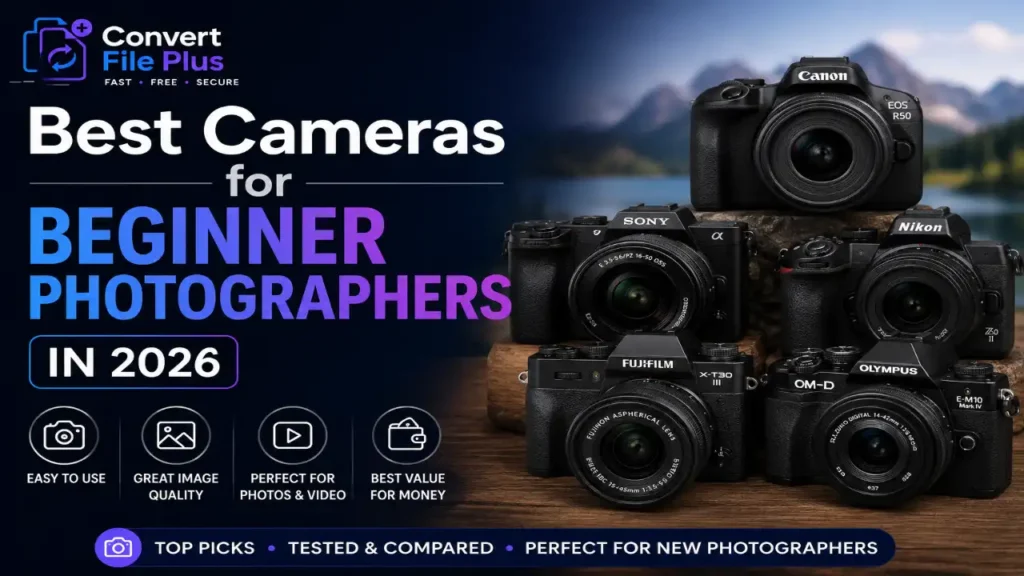
Canon EOS R50 – Best All-Around Pick
This one keeps showing up at the top of nearly every list, and for good reason. The Canon EOS R50 hits a genuinely good balance of image quality, autofocus, size, and price for most beginners.
It’s not Canon’s cheapest option, but reviewers consistently say it’s the cheapest one actually worth buying. Its Dual Pixel CMOS AF II system can quickly lock onto a subject almost anywhere in the frame, with automatic recognition for humans, animals, and vehicles, according to Fstoppers.
Good for: people who want one camera that handles photos, casual video, and everyday shooting without much fuss.
Canon EOS R100 – Best Budget Option
If price is the deciding factor, start here. The Canon EOS R100 leads on simplicity and affordability, with guided menus, dependable autofocus, and an entry price around $449, according to PhotographyTalk’s 2026 testing.
It’s not flashy, and the video specs are basic. But for someone buying their very first interchangeable-lens camera, that’s arguably a feature, not a flaw.
Sony ZV-E10 II – Best for Vlogging and Content Creation
If the main reason you’re buying a camera is to make videos – YouTube, TikTok, product reviews – this is the one most reviewers point toward. According to Shotavix, it uses an APS-C sensor for nice background blur and solid low-light quality, and its real strength is a hybrid autofocus system that tracks human eyes, faces, and even animal subjects.
It even has a dedicated mode for product showcases, where the camera quickly switches focus from your face to a product you’re holding up. Genuinely handy if you review things on camera.
Nikon Z50 II – Best Ergonomics
Beginners tend to underrate how much hand-feel matters until they’ve held a camera for three hours straight at a wedding or a hike. The Nikon Z50 II delivers handling that, per PhotographyTalk, approaches professional-body feel despite its entry-level price.
Worth a look if smaller mirrorless bodies feel awkward in your hands.
Fujifilm X-T30 III – Best for Color Straight Out of the Camera
Fujifilm has built something of a cult following around its color science, and the X-T30 III keeps that going. One buyer’s guide from The Cotswold Photographer put it simply: the real appeal is the beautiful images it produces straight out of camera, paired with good autofocus and solid build quality for the price.
If you don’t love editing and want shots that already look right, this is worth considering.
Olympus OM-D E-M10 Mark IV – Best for Portability
Not everyone wants to lug gear around, and that’s fine. The Olympus OM-D E-M10 Mark IV is, per SIRUI’s 2026 roundup, one of the best compact cameras available, with strong in-body stabilization that makes handheld shooting comfortable.
One photography instructor who’s trained hundreds of students since 2014 went as far as calling it his personal top beginner pick, noting it’s fun to use and the most portable system around – high praise from someone who’s tested hundreds of cameras.
What About DSLRs? Still Worth Buying?
Short answer: probably not, unless you’re picking one up secondhand for very little money.
Mirrorless cameras have basically taken over the entry-level market at this point. Autofocus, video quality, and weight all favor mirrorless now, and most major manufacturers have slowed or stopped new DSLR development entirely, putting their R&D budgets into mirrorless mounts instead.
That said, a used DSLR can still make sense if your budget is genuinely tight and you’re not in a rush to shoot much video.
Matching the Camera to What You Actually Shoot
This is the part most lists skip – and it’s the part that actually saves you from buyer’s remorse six months later.
- Portraits and people: prioritize autofocus speed and eye-tracking
- Landscapes: prioritize dynamic range and weather sealing
- Travel: prioritize size, weight, and battery life
- Video and vlogging: prioritize screen articulation and stabilization
- Family and pets: prioritize low-light performance and how fast you can grab the camera and shoot
For travel specifically, prioritize size, USB-C charging, lens compactness, and JPEG quality that looks good straight out of the camera. For video, prioritize screen articulation, audio input, stabilization, and autofocus that tracks smoothly while recording – details confirmed across multiple 2026 buying guides.
That’s where things get interesting. Once you map your real use case onto these priorities, the “best” camera stops being a debate and starts feeling pretty obvious.
Don’t Forget the Lens
Most beginner cameras get sold “body only” or with a basic kit lens. One experienced photography teacher put it well: choosing the camera is only half the story, since the lens you use matters just as much – sometimes more – for how your photos actually turn out.
A kit lens is fine to start with. But know that within a year or two, you’ll probably want at least one more – a prime lens for portraits, maybe a wider one for landscapes. Budget for that upfront instead of treating it as a surprise later.
Final Thoughts
There’s no single perfect answer to which camera beginners should buy in 2026, and honestly, any guide claiming otherwise is oversimplifying. The best beginner cameras this year share a few things in common: dependable autofocus, sensible menus, and lens systems that won’t box you in down the road.
If you want the safest, most well-rounded pick, the Canon EOS R50 keeps earning that recommendation across independent tests. If money’s tight, the EOS R100 gets you into a real camera system without much financial risk. If video’s the priority, the Sony ZV-E10 II is genuinely hard to beat right now.
Most people don’t think about this until they’re already a year into shooting: the camera matters less than the habit of actually picking it up. The best beginner camera, in the end, is the one that doesn’t end up sitting in a drawer.
Whatever you land on, give yourself permission to take a lot of bad photos for a while. That’s how everyone – including the people writing these reviews – actually learned.

- Difference Between Image Resolution and Image Size: Complete Guide (2026) - July 13, 2026
- How Much Does AI Software Cost for Startups in 2026? - July 7, 2026
- How to Use AI to Write Blog Posts Faster Without Losing Your Voice - June 28, 2026