
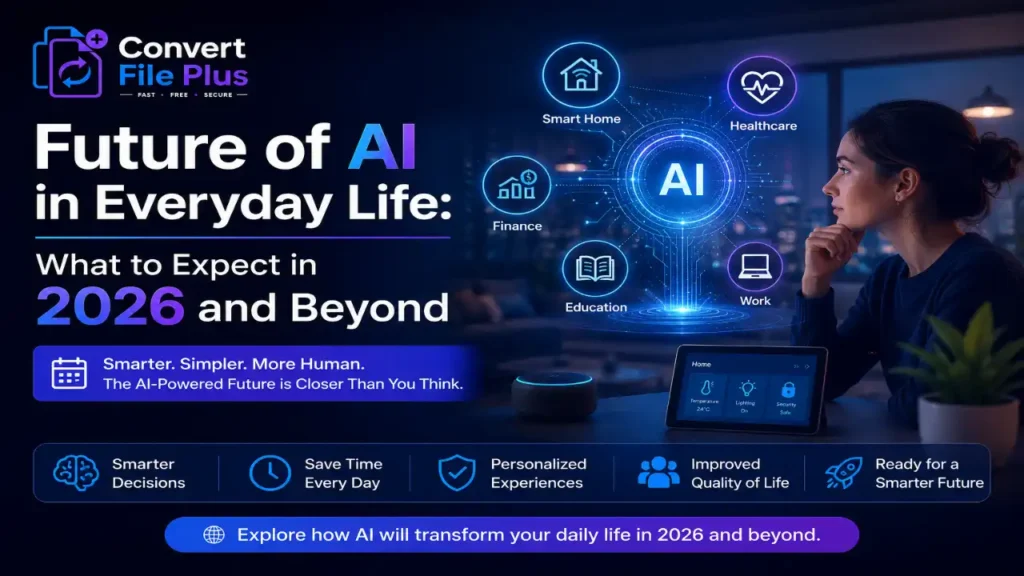
Most people upgraded their phones last year without realising they were also inviting an AI system into their calendar, their camera roll, and their email drafts. That quiet shift AI embedding itself into daily routines without fanfare is exactly what defines this moment. The future of AI in everyday life isn’t a distant science-fiction premise. It’s already underway, and 2026 is proving to be the year when the gap between “early adopter” and “average user” essentially closes.
Consider this: according to McKinsey’s 2024 State of AI report, 65% of organisations globally are now using generative AI in at least one business function up from just 33% the previous year. That adoption curve is steep. And while the enterprise numbers get most of the headlines, the real story is happening at the consumer level: in smart home devices, healthcare apps, personal finance tools, and education platforms that ordinary people use every single day.
It would be easy to dismiss this as overhyped. Honestly, a lot of early AI promises were. But what’s different now is that the tools are actually useful not just impressive in a demo. They save time, reduce friction, and in some cases, make decisions that used to require professional expertise accessible to everyone.
So where is all this heading? Let’s look at the areas where AI will make the biggest difference not just for companies, but for real people with real lives.
AI at Home: It’s Stopped Feeling Like a Novelty
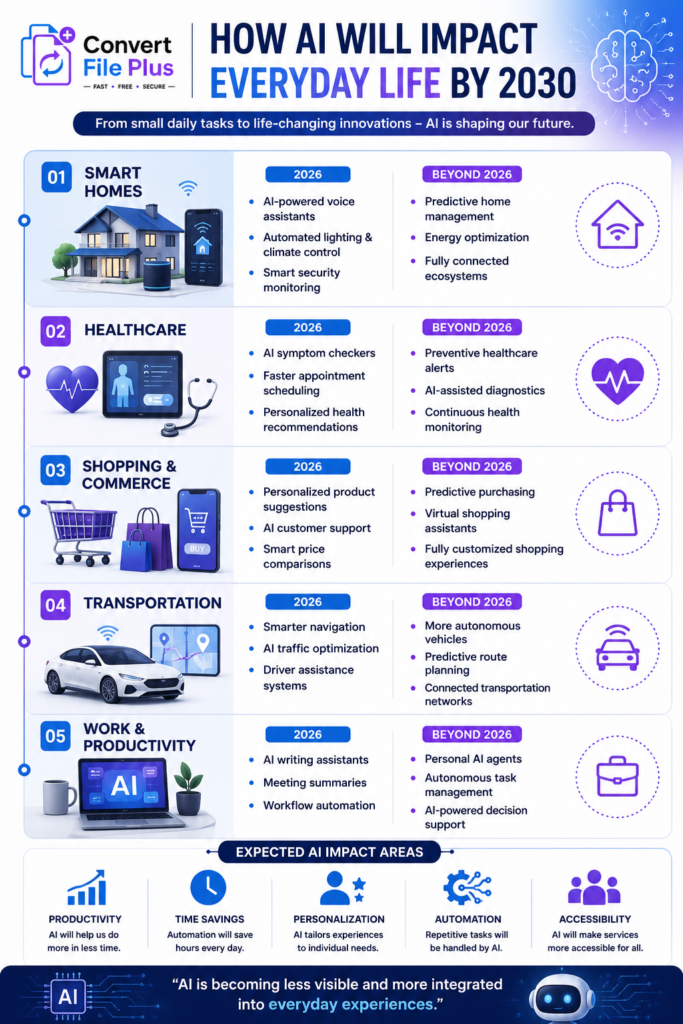
A few years ago, asking your smart speaker to set a timer was considered impressive. Now, the same device can manage your grocery list, adjust your thermostat based on your patterns, and even detect unusual sounds while you sleep. The shift from reactive commands to proactive assistance is subtle but significant.
What’s coming next in the home environment:
- Smart appliances that learn usage habits not just follow schedules and adapt without being told
- Energy management systems that predict peak usage times and automatically switch to lower-cost windows
- AI-powered home security that can distinguish between a delivery person and an intruder, reducing false alarms considerably
- Voice interfaces that understand context, not just commands so you can say “make it cooler in here” without specifying which room
According to Statista, the global smart home market is projected to hit $231 billion by 2028 (statista.com). Most of that growth will be driven not by early tech enthusiasts but by mainstream households looking for convenience and energy savings.
Healthcare: Where the Stakes Are Highest and the Potential Is Enormous
This is the area where the future of AI in everyday life gets both exciting and a little sobering. AI is genuinely starting to change how healthcare reaches people particularly those who don’t have easy access to a GP or specialist.
What’s already happening
AI symptom checkers, while imperfect, are helping people make better decisions about whether to seek emergency care. Wearables powered by machine learning like certain Apple Watch models and Fitbit devices can now flag irregular heart rhythms and blood oxygen anomalies in real time.
Gartner predicts that by 2027, AI will be embedded in more than 75% of clinical decision support systems (gartner.com). That’s not about replacing doctors. It’s about giving them better information, faster and extending some of that analytical reach to patients directly.
The everyday impact
- Mental health apps that adapt their approach based on how a user is responding not just offering a fixed library of exercises
- AI interpreters that help non-native speakers navigate complex medical conversations
- Medication management tools that track adherence and flag potential drug interactions
- Chronic disease monitoring systems that alert patients and their care teams before a problem escalates
Most people don’t think about this as AI. They think of it as “my health app.” That normalisation is, in some ways, the biggest development of all.
Personal Finance: Smarter Tools, But Don’t Ignore the Fine Print
Budgeting apps have existed for years. What’s different now is that AI is moving beyond tracking what you’ve already spent it’s starting to anticipate, recommend, and sometimes act on your behalf.
Some of what’s becoming mainstream:
- Real-time fraud detection that flags unusual transactions before you even notice them
- Personalised savings plans that adjust based on your actual income patterns, not an idealised budget
- AI-powered credit scoring that goes beyond the blunt instrument of traditional credit reports
- Investment platforms that offer portfolio rebalancing recommendations once reserved for high-net-worth clients
That last point matters. A PwC report on financial services AI (pwc.com) noted that AI-driven personalisation is starting to democratise wealth management advice. The caveat? Users still need to understand what they’re agreeing to when an app makes decisions on their behalf. Automation is powerful. Blind automation is risky.
Education: The Classroom Is Changing Slowly, Then All at Once
If there’s one sector where the future of AI in the next 5 years looks genuinely different from today, it’s education. Not because the technology is most advanced there but because the need for personalisation has always been so obvious, and the traditional system has been so poor at delivering it.
AI tutoring tools are already giving students on-demand explanations that adapt to their level. A student who keeps getting a particular algebra step wrong doesn’t need the same explanation louder they need a different approach, and AI is increasingly good at finding it.
What to expect in the coming years:
- Learning platforms that identify gaps in a student’s understanding before tests reveal them not after
- AI writing assistants that teach, rather than just correct explaining why a sentence structure doesn’t work, not just fixing it
- Language learning apps that get genuinely conversational, not just transactional
- Tools that support educators in identifying students who may be struggling emotionally, not just academically
The World Economic Forum has estimated that around 1 billion people will need reskilling by 2030 (weforum.org). AI-powered learning is one of the few plausible ways to meet that scale. Traditional education institutions can’t do it alone.
AI at Work: Less About Replacement, More About What You Do With Your Time
The conversation about AI and jobs has been dominated by fear of automation. That’s understandable some roles will change significantly. But the more interesting story is about what happens when knowledge workers get AI as a colleague rather than a competitor.
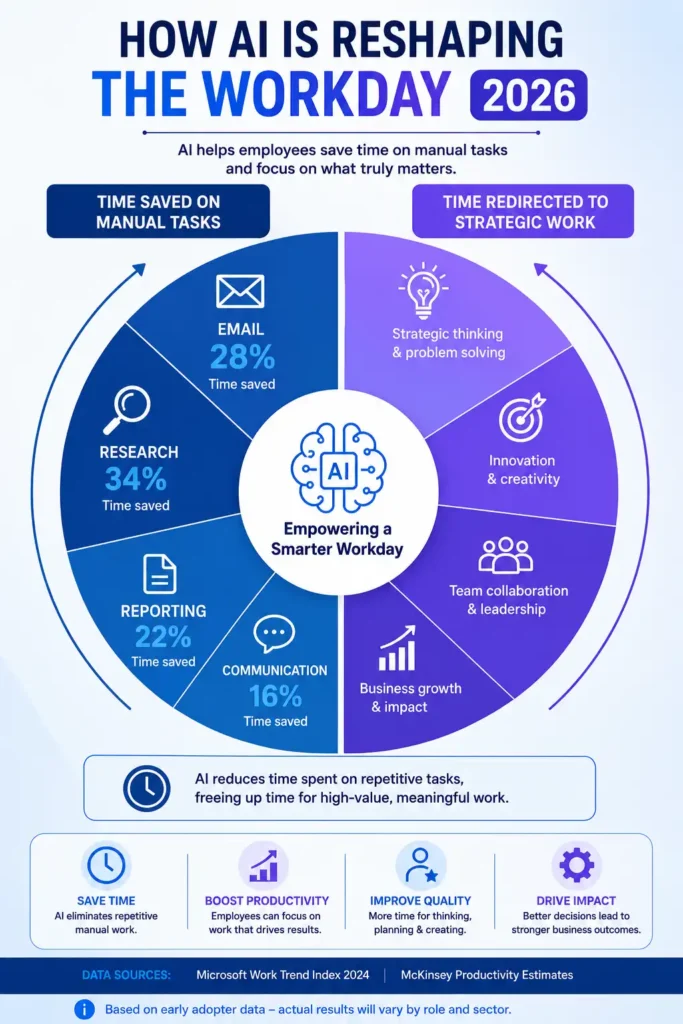
Most people using AI tools at work today whether for drafting emails, summarising long documents, generating code, or researching competitors report that the biggest benefit isn’t speed. It’s cognitive offloading: being able to focus on the judgment-heavy parts of their job rather than the mechanical parts.
Microsoft’s 2024 Work Trend Index (microsoft.com/worklab) found that 70% of early Copilot users said it made them more productive, and 68% said it improved the quality of their work. Those aren’t small numbers and Copilot isn’t even close to the ceiling of what these tools will do.
The Challenges Nobody Should Gloss Over
It’s easy to focus on what AI can do well. It’s more useful to be clear about where the friction will remain because that’s where most people will actually struggle.
None of these are reasons to avoid AI tools. But they’re reasons to use them thoughtfully which, frankly, applies to most powerful technologies.
What to Actually Expect A Grounded View
The future of AI in everyday life won’t arrive as a single announcement or a product launch. It’ll arrive the way most significant shifts do: gradually, then unavoidably. By 2028 or 2029, the people who haven’t integrated AI into how they work, learn, manage their health, and organise their time will likely feel the friction of that gap much more acutely than they do today.
That said, this isn’t about chasing every new tool that drops. The most useful frame is simpler: where do I spend mental energy on tasks that aren’t my actual expertise? That’s where AI tends to add the most value and where the future of AI in the next 5 years will concentrate the most development effort.
Healthcare, education, and personal finance are likely to see the most visible changes for average people because the existing systems in those areas are expensive, inaccessible, and frankly slow. AI won’t fix all of that, but it will chip away at it in ways that genuinely matter.
There’s something interesting about the moment we’re in right now. The tools are powerful enough to be useful, but most people are still figuring out what questions to ask of them. That learning curve not the technology itself is probably the most important thing to navigate. The best use of AI isn’t automating what you already do. It’s rethinking what’s worth doing in the first place.

- Difference Between Image Resolution and Image Size: Complete Guide (2026) - July 13, 2026
- How Much Does AI Software Cost for Startups in 2026? - July 7, 2026
- How to Use AI to Write Blog Posts Faster Without Losing Your Voice - June 28, 2026